
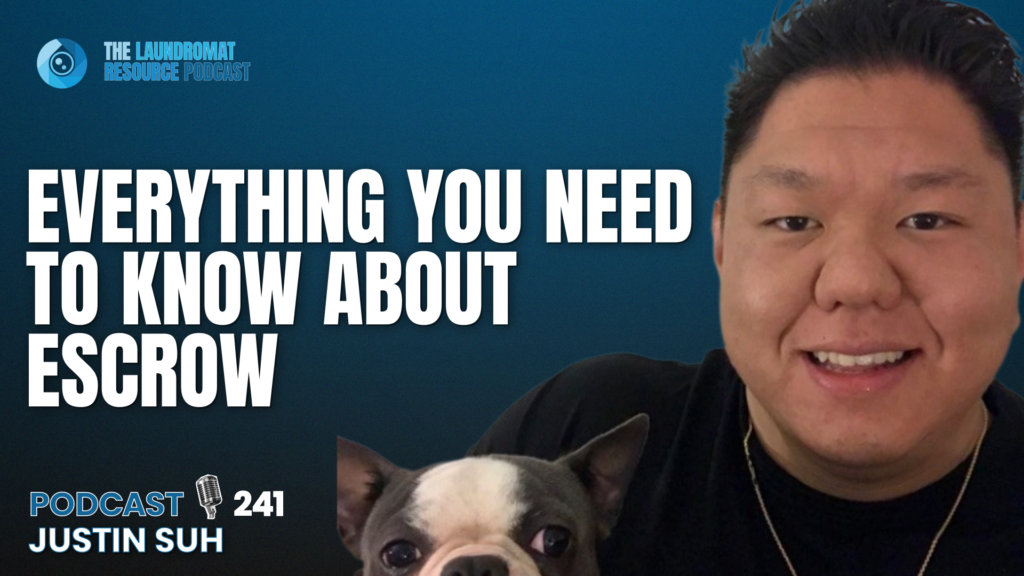
Welcome back to the Laundromat Resource Podcast! In episode 241, host Jordan Berry dives deep into the often misunderstood world of escrow, especially tailored for those looking to buy their first laundromat. Whether you’re just starting out or need reassurance during your first transaction, this episode aims to demystify escrow and set you up for success.
Joining Jordan Berry is escrow expert Justin Suh from New Century Escrow, California. Together, they break down the essentials: what escrow is, why it’s critical for buyers and sellers, and how it protects everyone involved. Justin Suh offers insider tips and explains how to avoid common pitfalls, from clearing tax liens to handling SBA loans, and emphasizes the value of working with experienced brokers.
If paperwork isn’t your strong suit or you’re worried about inheriting unwanted liabilities, don’t miss this episode. Plus, stay tuned for a live Q&A segment, where audience questions get addressed in real time.
Ready to take action? Tune in, learn something new, and discover what you can implement this week to move closer to your laundromat goals.
Importance of Using an Independent Escrow Company for Transactions
Justin Suh emphasized that escrow serves as a non-biased third party to protect both the buyer and seller. Escrow companies ensure that all agreements are mutually signed, verify that the buyer has funds, and check that any seller liabilities—such as tax liens or loans—are paid off before the business changes hands. This protects new owners from inheriting unexpected debts and legal issues.Thorough Documentation and Payment Handling
One of the biggest perks for owners—whether buying or selling—is that the escrow company handles all the convoluted paperwork and disburses funds correctly. Jordan Berry highlighted that escrow manages payments to lenders, brokers, and sellers, ensuring all liens are cleared. This makes the transaction smoother and guarantees owners won’t be left chasing paperwork or worrying about missed payments.Preparation and Relationships Matter
Both for buyers and sellers, being prepared is key. Justin Suh advised that buyers should ensure their finances and funding are lined up, and landlords are pre-approving them as tenants. Sellers should have business licenses and property tax bills ready, and address any outstanding SBA loans ahead of time. Good relationships with the other party and with brokers also help, as personality clashes or unprepared parties are a common reason deals fall through.
Ready to Take the Next Step?
Check out Laundromat Resource for free courses, podcasts, community forums, and expert consulting—all from Jordan Berry , one of the industry’s leading voices. The opportunity in laundromats is real—whether you’re looking for stable cash flow, a business with meaning, or building wealth with real estate.
If you found these tips helpful, share them—and stay tuned for more industry insights from Laundromat Resource.
Resources and Links:
- Laundromat Resource
- [email protected]
- LinkedIn: Justin S.
- Website: newcenturyescrow.com
Make sure to watch the latest Laundromat Podcast Episode 241
Jordan Berry [00:00:00]:
Hey, what’s up guys? It’s Jordan with the Laundromat Resource Podcast. This is show 241, and I am pumped as always that you are here today. Today, this one’s probably more for the newbies. So if you’re out there looking to buy your first laundromat, this is actually going to be super educational and helpful for you. We’ve got on the show a super special guest, a buddy of mine, Justin Sue, who is with New Century Escrow out of California. And we’re talking all things escrow. So if you don’t even know what I’m talking about right now, or you’re not sure what happens, during escrow. This one’s going to be super valuable.
Jordan Berry [00:00:34]:
It’s going to help you feel a lot more comfortable during that first transaction. And Justin is a rock star. I cannot think of anybody better to do a, a podcast episode on laundromat escrows than Justin. And we also got a live Q&A in store for you. So make sure you stay tuned for that. But hey, before we jump into any of this with Justin, I just want to say that I’m in your corner. And I say this at the end of every single episode, but I’m going to say at the beginning of this one, because it’s so important. I know some of you guys don’t make it all the way to the very end, right? I start talking at the very end and you’re tuning out already.
Jordan Berry [00:01:15]:
So listen, this episode, every episode in the past, every episode to come, every other podcast that’s on business or personal development, all of those are incredible resources, amazing that we can have the information that we have today, these days. However, however, listening to them, watching YouTube videos, scrolling on TikTok or whatever you’re doing out there, all a waste of your time if you don’t put stuff into action. So every episode you listen to of the Wander My Resource podcast, every episode of any other business, personal development, et cetera podcast you listen to, try to pick one thing to put into action. And this is no exception. So listen, we’re going to jump into it with Justin right now. Find one thing to put into action today, if possible, but at the very least this week, and let’s stack those actions week after week and you’ll hit those goals.
Jordan Berry [00:02:12]:
All right. All right.
Jordan Berry [00:02:13]:
Let’s jump into it with Justin talking all things escrow. Justin, thank you for coming on the show, man. How you doing?
Justin Suh [00:02:21]:
Good, good, brother. I appreciate you having me on here.
Jordan Berry [00:02:24]:
Yeah. Oh dude, it’s my pleasure and an honor to have you on here. I’m super excited actually. I think, you know, some people might hear this topic and be like, oh no, like we’re going to talk about what? But this is, you know, we were just talking like this is a critical part of the transaction of buying a laundromat or any business or even a house really. And so, and I think a lot of people don’t understand what it is and what’s happening. And I think a lot of people don’t know how to set themselves up for success. So I think this will be really great to kind of talk through. Before we jump into escrow and what all that is and everything, why don’t you just give us a quick background on you and then we’ll jump into it?
Justin Suh [00:03:05]:
Yeah. So I’ve been an escrow officer for about 4 or 5 years, but I have about 9 years of experience. This has been kind of a a family business, and we’ve been kind of running it. And, uh, Helen has been in the business for 25 years plus, so she’s been kind of like the, uh, the main focal point of, uh, all the coin laundries. I don’t know how she hopped into it, but, you know, I guess she just knew what to do. And then all these agents and brokers started just kind of calling at her and, you know, just kind of getting the business going. And so, um, you know, here I am. So I figured she needed help, and you I helped her a lot and she’s been helping me with learning everything too.
Justin Suh [00:03:48]:
And so we’re here to just help people and just do honest work. That’s all we’re trying to do. We’re trying to make sure everybody’s protected and happy and trying to do the best we can.
Jordan Berry [00:04:00]:
Yeah. Real quick, why don’t you tell us your company name and where you’re operating out of?
Justin Suh [00:04:07]:
Oh yeah. So our company name is New Century Escrow. We’re located in Brea. So if you’re in Orange County, feel free to stop by. Just give us a call ahead of time. Don’t just walk in, but just give us a head that you’re going to walk in, you have some questions. I’m happy to help anybody who walks in that has questions. I’ve had a few people do that and it’s been really, really great.
Justin Suh [00:04:30]:
And I’ve met very, very great people through that.
Jordan Berry [00:04:33]:
Yeah. You got to be careful saying stuff like that on here. I might have to edit that out for you. Otherwise you’re going to get bombarded. But hey, go make a friend with Justin and let him know if you’re in the SoCal area. Do you guys service— what areas do Do you guys service specifically? I know this is not for everybody. I just want to put it out there.
Justin Suh [00:04:51]:
Oh yeah. I mean, we service all over California. Okay. You know, as long as it’s within California, it doesn’t matter if it’s NorCal or SoCal or wherever it is, it could be anywhere. So as long as it’s within California, we can handle any transaction.
Jordan Berry [00:05:06]:
Yeah. Awesome. And I’ll just say, you know, up front before we really jump into it here, I’ve utilized you guys as an owner who was buying, as an owner who was selling, and as a broker. And also I’ve had a ton of consulting clients. Views, you guys. So you guys are all over the place doing a lot. I’d say— I don’t, I don’t know this to be a fact, but I, if I had to bet money on it, I’d feel pretty safe betting money that you guys do the lion’s share of the transactions in at least in Southern California, if not all of California.
Justin Suh [00:05:35]:
So, well, I appreciate it. I mean, we’re just, you know, just trying to work hard and just do the honest right thing and not screw people over, because I know especially in, um, you know any kind of real estate industry. There’s just a lot of, just a lot of bad, you know, bad people and just bad apples. But I mean, there’s good people like us, you know. I’m not trying to say, you know, I’m a good guy, but, you know, I just try to do the—
Jordan Berry [00:05:59]:
I’ll say it, I’ll say it, you’re a good guy. You guys, you guys do, you guys do it right. And, and I’ll say real quick up front too, if you’re not in California, this episode is still for you. This is all about— this is not California. Some of this stuff might be a little bit California specific, but Most of this is going to apply to anybody anywhere who’s doing a transaction for a laundromat deal. So I just wanted to put that out there so you don’t just tune out right away if you’re in, you know, Timbuktu, which is what we call everywhere except California. I’m just kidding. Yeah, that’s right.
Jordan Berry [00:06:32]:
That’s right. All right, Justin, break down what is escrow, you know, and What is that process like? And then maybe we can jump into what your company does or an escrow company does. But what is escrow? Can you just define that for us?
Justin Suh [00:06:49]:
Well, escrow is a non-biased, independent company. Sometimes there’s in-house companies also when it comes to real estate, but when it comes to bulk sales, I believe that they have to be an independent escrow company. And we as an escrow company are a non-biased party that we’re looking at the best interest of both the buyer and seller. We can’t favor more toward the buyer. We can’t favor toward more the seller and let him slide on certain things or let the buyer slide on certain things. We have to uphold what your agreement is stating and what you guys agreed upon and that you guys both countersigned and that you guys both initialed on. If it’s not signed by both parties and not agreed upon, we cannot start escrow. We can’t have an agreement that’s just signed by the seller and then A broker comes to me and say, “Hey, I got this agreement, but it’s only signed by the seller.” I’m like, “Well, we can’t really start because this is not mutually agreed.” It’s just like anything else.
Justin Suh [00:07:46]:
If it’s not mutually agreed, we don’t really have an agreement in place. So that’s important to also think, especially for for sale by owners, to have an agreement signed by all parties. I can’t work with just a draft of blank thing because we don’t want to get caught up in any kind of fraudulent things or any kind of weird, wonky, funky— There’s all sorts of weird things that we’ve seen. I mean, people said this fraudulent checks all the time. We’re like, dude, what are you guys doing? And so us as an escrow company, we’re making sure we’re upholding the agreement for all parties. If the buyer says, I’m depositing this amount and I’m getting financing for this amount, then we’re going to be following that. Obviously that will change in the course of the transaction, but mainly our job is to make sure that the buyer has the verified funds, to purchase this business, because as a seller, you want to make sure that the buyer has the money, right? That’s the most important thing. And then us, for the buyer, we have to make sure that we’re cut— we’re paying off all the loans or any kind of tax liens or any kind of taxes that’s owed by the seller to make sure that it’s not going to be falling on the buyer.
Justin Suh [00:08:57]:
Meaning, like, for example, you know, we get tax clearances from CDTFA, which is California Department Tax and Fee. That’s only applicable for coin laundries that may have vending machines, that you’re selling tangible goods, whether it’s soap, you know, snacks, or anything of some sort that’s a tangible individual good, they want you to make sure you’re reporting that and also have a seller’s permit. If you don’t, sometimes they do look into it and they might possibly audit you depending on how many vending machines you have and how much you’re generating. They might possibly audit you if you don’t have a seller’s permit. So that’s really, really important if you’re planning to sell any tangible goods in your coin laundry., and you own the vending machines, then you definitely want to get a seller’s permit and register immediately and file your sales and everything else with it. If you’re not sure, I would highly get with the CPA, possibly can help you. Um, we can’t help you because we’re not authorized or licensed to do any of that stuff. So highly get with the CPA on that one.
Justin Suh [00:09:55]:
And then we also, uh, request a tax clearance with the Employment Development Department, um, making sure that you don’t have any employee wages or taxes that you that you might have not been filing or whatnot and stuff like that. And then also we also asked about Franchise Tax Board, do they have any state taxes that they owe and stuff like that? So we clear up all this stuff to make sure because not more so Franchise Tax Board, but EDD and CDTFA, if any liability is not paid by the seller. And let’s say for example, if they transfer, let’s say you don’t use escrow, you transfer over a store, you buy it from a buddy or something like that and you find out the seller has an astronomical amount of employee taxes and sales tax— Oh, sorry, my office has to turn off. But what happens is they consider successor’s liability, meaning that if the seller has all these liabilities that they owe and the buyer takes over and you don’t use escrow, you’re going to be liable for all those taxes that that person has not paid. Also including unsecured property tax bills. And so you as a buyer, that’s why we recommend to use an escrow company, is because we dig up all this dirt for you so you don’t have to worry. So when, when you take over the business, it’s a free clean slate of a business. You don’t have to worry about, you know, the tax collector coming after you, you know, filing liens against your business and then possibly shutting you down depending on what county you’re in.
Justin Suh [00:11:27]:
So I know Orange County is very very strict on that. So if you don’t pay your taxes and you have 4 or 5 tax liens, they’re possibly going to come into your business and shut it down. LA County, I’m not too sure. They say they do, but sometimes I feel like they don’t because some businesses, we have 6, 7 tax liens that haven’t been paid and they’re still operating. So it just depends on the city and where you’re in. Sometimes they have different codes and they have different regularities and all that stuff. So it’s just a fair warning to anybody that’s looking into purchasing to definitely use an escrow company to look up all that stuff for them so they don’t have to stress out. And it’s already stressful purchasing a business because you’re looking at records, you’re doing the coin counts with the seller, you’re also negotiating with the landlord on a feasible lease that’s going to make sense for you and making sure that you’re going to have a profitable business.
Justin Suh [00:12:24]:
Because I mean, at the end of the day, you’re buying a business to make money, right? And if you can’t make money and you’re already starting in the negative, I mean, nobody wants to buy a business like that. So that’s where we come in and we make sure everything is clean for you. So when you start, you’re starting off a fresh start, you know. So that’s kind of what we do. And if there is a lender involved, we do all the paperwork for you. We, you know, we provide everything that they need to kind of get the funding going to make sure that, hey, this is a legitimate sale. And most likely, if you’re going to use a lender or get a lender for funding to purchase a business, most likely they’re going to want you to go through escrow because there’s all these different things that we do like publication and UCC. They want to make sure that, okay, they’re getting all the dirt out and making sure that, hey, if we fund this business, we’re not funding a business that’s into the negative already.
Justin Suh [00:13:14]:
Because as a lender, you’re also in the money-making business because you want to make sure your client or your borrower is also successful so that they can pay off their loan. Nobody wants to lend to a person that’s not making money, right? Because then they’re going to default, then everything’s going to fall apart, then all your money’s gone. So that’s kind of what we do. Yeah.
Jordan Berry [00:13:37]:
Well, I mean, listen, if anybody’s out there listening to this and being like, I don’t even know what he’s even talking about, I mean, and I think that’s kind of the point, right? Is like, there’s a lot of Uh, there’s a lot of risk in buying a business, right? There’s a lot of risk, you know, and we talk about this a lot on the acquisition side from the like, hey, this is a cash business, it can be difficult to determine how much money you’re actually making in the business, how much money is actually going out in the business. You kind of mentioned that. Yeah. Um, and so there’s, you know, there’s risks there when you’re buying a business or any asset really.
Justin Suh [00:14:14]:
Yeah.
Jordan Berry [00:14:14]:
Um, but in addition to that, there’s these other risks that you’re talking about, right? Where if the seller has these liabilities and they don’t get paid off, you can inherit them. Uh, the other, uh, the other thing that, you know, the thing I appreciate most about what you guys do honestly is all that stuff, but also, uh, listen, paperwork is like not my strong suit. It’s not my strong suit over here. And so just having, having you guys kind of go through all the paperwork, making sure everything’s in line, making sure all the signatures are there for all the different forms that need to be filled out. Yeah. All that is, I mean, I think that’s an underrated, at least for me, that’s an underrated service you guys provide. Make sure the paperwork’s all in line.
Justin Suh [00:15:01]:
Yeah. I mean, there’s always a lot of paperwork. I mean, there’s not only, there’s a lot of paperwork in general. I mean, we have to make sure everything is countersigned, you know, because if nothing is signed mutually and we start moving forward, we’re acting out of line in our realm. And you have to make sure that everybody mutually agrees. Even when it comes down to credit for repairs, we have to make sure everybody agrees. We can’t have the buyer accusing seller, “Oh, well, this wasn’t fixed,” and blah, blah, blah. But if you have a clause in your agreement that says, “Well, I’m taking equipment as is,” you don’t really have any grounds to claim that credit.
Justin Suh [00:15:40]:
But I mean, there is adjustment depending on how cool the seller is, the seller would be like, okay, well, I’ll give it to you. Okay, that’s fair. But in reality, if you’re saying, oh, I’m taking the equipment as is, then you’re going to be taking it as is. There’s no questions or buts. Nothing’s going to be repaired. And so that’s also important to have those type of clauses to make sure you’re protected. So that’s why a lot of those clauses need to be in there to make sure like, hey, I’m protected as a buyer, you’re protected as a seller. And so that’s where also an experienced broker or agent comes in to have those clauses in there to make sure he’s protecting all clients, you know.
Justin Suh [00:16:22]:
And yeah, that’s why I would say, you know, get with an, uh, you know, experienced broker or agent, um, in the coin laundry business, not real estate, because real estate and business is two separate things. And I hear a lot of complaints about, um, you know, some clients that had real estate agents as an agent in this business transaction, and they’re completely lost. But they chose them because they’re asking a small percentage of the commission, right? It’s like they’re asking 3%, which is— you’re absolutely undercutting all the other experienced brokers. I mean, yeah, the experienced brokers are going to be charging about— I’ve seen them up 6, 7%, just depending on whatever, you know, they could charge whatever depending on how difficult the transaction is, you know. Yeah. And, uh, just because someone’s cheaper, I mean, just like anything else, um, you get what you pay for, you know. And that’s where I think you— I think clients should really consider it. Yes, it’s a little bit upfront, but it’ll definitely, definitely save you the headache of a lot of other things.
Justin Suh [00:17:29]:
Because if you have an experienced broker agent, they can be like, oh well, we can add this into the agreement, or we can add this into the agreement to make sure you’re protected. And they can sort it out with you. And that’s why it’s really important, because if you do a for sale by owner and you’re just kind of jimmy-rigging a purchase agreement, I mean, that’s where it’s like, I can’t help you. I can only do so much as an escrow company. I can’t do the agreement for you and everything because we’ll be acting out of line. That’s not us. That would be something an agent or a broker or possibly an attorney that can help you assist with that. So don’t come at us and saying, “Hey, can you help me just do an agreement?” I can’t do that.
Justin Suh [00:18:09]:
You know, so don’t come at us trying to think that we could do— wear all these hats. We’re just here to make sure that, you know, everybody has the money in and, you know, following the agreement, all that stuff, and making sure everybody’s kind of playing by the rules, you know.
Jordan Berry [00:18:22]:
That’s right, that’s right. Yeah, talk to your broker or call us. We’ve got, uh, people that can help you with that as well, no matter kind of where you’re at. Put that together. Uh, well, and the other thing that I, I’d say too is that the, you know, the, the broker— a good broker can help you with, um you know, getting those clauses in there, making sure contingencies are, you know, in line with, with what they need to be for that particular business. And there is some nuance with those, but usually— and I guess, I guess I’m a little biased because I’m a broker over here. I don’t do a ton of brokerage, but I do a little bit here and there. Yeah.
Jordan Berry [00:18:55]:
And, you know, usually you’re going to get more. I know you’re going to pay for a broker, but usually you’re going to get more, more money for it if you use an experienced laundromat broker or small business broker who understands the business there too.
Justin Suh [00:19:11]:
Well, I think the other important—
Jordan Berry [00:19:13]:
Yeah, go ahead.
Justin Suh [00:19:14]:
Sorry.
Jordan Berry [00:19:14]:
Sorry.
Justin Suh [00:19:15]:
Oh no, sorry. I didn’t mean to cut you off, but I think it’s really, really important because unless the buyer and seller are very— they kind of know what they’re doing or they’ve been around the block for many, many years, but if you’re a newcomer or somebody who’s just trying to get into the business because on the internet you saw our whatever, and you’re just not sure, you’re not even know what to look, it’s highly, highly, highly recommended to get with an experienced agent and a broker because they can walk you through, and that’ll be like your first step of learning experience, especially if you’re trying to be serious in this industry. It’s a great stepping stone and then also a great tool. And then depending on how your broker and agent and what your relationship with is, you can also call them up for consulting, like, hey, I’m trying to buy this and I don’t know what I’m looking at, or I don’t know what I need to look for. And this is where they come in with the expertise and they kind of walk you through like, hey, you need to look out for this or blah, blah, blah. And so that will help you as a person. Yes, it’s going to cost money, but I mean, everything’s going to cost money and it’s definitely going to help you deal with less headaches down the road. Because if you don’t and you acquire this coin laundry, you don’t know what to look for and the seller kind of gives you with a coin laundry barely on its last leg, and it’s, it’s going to be bad, you know, and you’re going to be forking out more money just to fix everything and just to make sure that you just recoup all your money.
Justin Suh [00:20:45]:
And nobody wants to go through all that, you know.
Jordan Berry [00:20:48]:
Yeah, yeah, yeah. Well, okay, so, you know, one, one thing I get asked a lot is, you know, if I’m, if I’m buying a laundromat and there’s like a deposit or something, do I give that to the owner? Do Do I give that to the broker? And I mean, obviously, like, the answer to that is no, you don’t. You don’t do that. And I’ve spoken with multiple people who have gone that route and who’ve given, like, earnest money to a deposit to the owner for them to hold, and then the transaction fell through and it was like pulling teeth to try to get that money back. And it was not good. So talk to me about how, how does escrow help with the money? The money issue here?
Justin Suh [00:21:31]:
Yeah. So initially, before we start anything, we start drafting escrow instructions, we need a deposit, right? That deposit is just in place in case of, let’s say, for example, if we get our process going, we’re starting to get everything, we start doing our due diligence, we’re paying third parties to look up certain records and stuff,. And so those costs are non-refundable. So we have to make sure we have some funds on hold to make sure we cover those costs. And then we always ask, we always ask the clients before moving forward, are you okay with this? This is a non-refundable thing that we need to pay for. Are you okay with it? Are we moving forward to make sure everybody’s serious and everybody’s on board that, hey, I’m really purchasing this business? Because in our line of business, we have so many people like, yeah, yeah, yeah, I’m serious, I’m serious, I’m serious. And then no deposit comes “And we’re like, okay, well, nobody works for free. Nobody’s going to work on it if we don’t have money.
Justin Suh [00:22:31]:
We don’t have skin in the game. You’re not really serious.” It’s like once we see the deposit, we’re like, “Okay, you guys are serious. Let’s do our work. Let’s start moving it.” And then that’s when we kind of do our due diligence and stuff like that. So I mean, that’s very important that the deposit needs to come through escrow for that reason. And there’s other people, especially sellers, they’ll be like, “Oh, well, that deposit’s supposed to come to me.” I’m like, Well, is it in your agreement? And did the buyer agree upon that? And if they didn’t, then I can’t do that legally. I’m sorry. But they’ll fight tooth and nail and be like, “I was a real estate broker,” and this and that.
Justin Suh [00:23:08]:
I’m like, “Okay, that’s great, but real estate and bulk sale or business transactions are two separate things. You can’t mix those things. They operate totally different on a different way.” And I would say that bulk sale is a lot more complicated and more intricate because there’s so many liabilities that you have to worry about. And with real estate, it’s a little bit kind of just— it’s already— the work is already cut out for you. You’re just like, okay, well, we just get the, you know, get this in, the loan, and then bada boom, bada bang, we’re recording, and then that’s it, you got your property, right? But with bulk sale, there’s so many liabilities. You know, people pull out SBA loans, people pull out, you know, loans for the equipment, And so we have to make sure those are all taken care of because we don’t want anybody to come after us and we don’t want anybody to come after the buyer because that’s unfair because that’s not their loan. And so that’s where I feel like people need to understand is that bulk sale and real estate are two separate things. And any real estate agent who’s trying to get into these bulk sale transactions, Please don’t ever think it’s the same thing.
Justin Suh [00:24:22]:
It operates totally different. Get with an advisor or a mentor to walk you through and show you what you can and can’t do also. So that’s just a little tip for the people that are— Because I know with the real estate market right now, it’s slow and a lot of people are trying to venture out into different venues or things to do. But yeah, if you’re a real estate agent or a realtor trying to get into this bulk sale thing or business transactions, definitely get with a mentor or somebody who’s very, very experienced to kind of walk you through and just help you and like overlook if you’re doing the right thing.
Jordan Berry [00:24:58]:
So, and it saves us a lot of time.
Justin Suh [00:25:02]:
Yeah. Yeah.
Jordan Berry [00:25:02]:
And just, you know, side note, if you’re looking for somebody to help you kind of get into that route, we’ve got a, we’ve got a, an option for you to, to kind of help you make sure you’re going the right path there. So reach out.
Justin Suh [00:25:18]:
Yeah.
Jordan Berry [00:25:18]:
Yeah. So real quick, just so everybody’s on the same page, I mean, you’ve used the term bulk sale and I think everybody can infer that’s selling a laundromat, but can you just define, what do you mean by bulk sale? And you’re contrasting it to real estate. So what do you mean by bulk sale?
Justin Suh [00:25:33]:
Yeah. So bulk sale would just be like a business transaction. I would just say it translates into just a business transaction. I think that’s just a fancy word of a business transaction in a way. And so that’s what it is. I mean, it’s just pretty much when you hear bulk sale, just think of it’s a business transaction. It’s not a real estate transaction. So that’s the differentiation on that one.
Justin Suh [00:25:57]:
So that’s what I understand it as. I mean, maybe other people have different definitions, but that’s how I see it.
Jordan Berry [00:26:04]:
Yeah. And typically, I mean, from my— and correct me if I’m wrong here, but from my understanding, Typically when you want to buy, you know, seek legal advice, not legal advice, but typically when you want to buy a laundromat, you want to do an asset purchase and you’re not necessarily buying the LLC or the S corp most of the time. And so what you’re doing is you’re buying all these separate assets. And I think the bulk sale refers to the fact that you’re buying multiple assets for this kind of asset sale on the business transaction.
Justin Suh [00:26:34]:
Yeah. And we, and we list it out, you know, we list out exactly what’s going to be included. And we list out exactly what’s included. They always say, “Oh, well, the trade name’s not included,” or sometimes it is. It just depends on what agreement that you guys come with. And yeah, technically you’re not buying the seller’s entity, but for the new people that are kind of looking into starting an entity, you can always initially start the agreement as an individual. And then amidst the process, when you kind of get more deeper into the escrow transaction, you can definitely Definitely start the entity because obviously everybody wants to make sure, okay, I’m purchasing this business. I don’t want to start an entity beforehand.
Justin Suh [00:27:17]:
And then what if I don’t purchase business? Then you’re paying annual state fees for just having an entity. And obviously a lot of people try to avoid that because they want to make sure they’re in the middle of the transaction to kind of change into the entity, which is totally possible. So don’t feel like just because you put yourself as an individual on the agreement that you cannot change it to your new entity that you registered for. So that’s where a lot of people kind of get confused on. So I always tell them it’s okay, you can change it in the midst of it, as you know, doesn’t matter.
Jordan Berry [00:27:51]:
Yeah. And I mean, I think that’s great because I get asked that all the time, like when do I need to start my LLC? I’ve got a lot of people who start that LLC or S corp or whatever they do.
Justin Suh [00:28:00]:
Yeah.
Jordan Berry [00:28:00]:
Like before they even start looking. And, you know, some places I think that’s fine. In California, I mean, as soon as you start that thing, You know, the, the money starts rolling out, right? You got to pay franchise tax board. Yeah, I know. Yeah, yeah, yeah. You got that $800 fee or whatever it is these days. And then, you know, it costs more to file taxes for, you know, an LLC or an S corp, you know, if you’re using somebody. And even if you don’t make money that year, you still have to file.
Jordan Berry [00:28:30]:
And so, yeah, um, yeah, so I think that’s great. And so, you know, just to kind of reiterate what Justin’s saying is you can make the offer in your name. And typically what we do is we include like, hey, this offer is from Jordan Berry and/or assigns or something like that, where now I can start my entity, my LLC, my S corp, whatever, and assign my contract to that during the escrow period so that it closes under that.
Justin Suh [00:28:56]:
Yeah. And, and sometimes the agent or the broker can And if the buyer’s really adamant, I mean, you can always set an amendment if the buyer wants to see something in writing. All buyers are different. Some are easygoing, some are like, “No, I want everything in writing.” So I mean, sometimes they’ll ask for an amendment and that’s okay. That’s totally fine too. So it just depends on how the client is and what kind of, I guess, character they are that if they want it in writing, sometimes they’re okay with just having escrow state it like, “Oh, hey, this person is this entity now.” So yeah. We can handle all that. It’s not a problem.
Justin Suh [00:29:29]:
It’s usually not a big deal. It’s not a big change or anything like that. So it’s just more of the taxes.
Jordan Berry [00:29:36]:
Yeah, right, right, right. And I— we talked about this. I just want to make sure that we were like clear on this. One of escrow’s job is to just disburse all, all the money to everybody where it needs to go. Right. And one of the huge benefits specifically for a buyer, but also for the seller in terms of just ease of, of everything is, you know, all the money is going to you and then it goes out from you guys to the lenders or anybody who has a lien on the property. It goes to the agents or the brokers and then it goes to the seller, whatever is kind of left over. And so as a buyer, you can have peace of mind that all the liens have been paid off.
Jordan Berry [00:30:19]:
They’ve been identified and paid off. As a seller, you don’t have to worry about getting this bulk sum and then sending it out to the lenders and all that stuff. That’s all taken care of by the escrow company.
Justin Suh [00:30:32]:
Yeah. So if, if let’s say, for example, if you have any financing with one of the only two big lenders I really know right now is Alliance, right? Eastern Funding. Those are like the two big giants right now in the financing equipment, especially in the laundry world.. And so they file what is called a UCC with the state, making sure, hey, this person under this entity owes us money, so you better pay us. And then once we pay them, we’ll handle the termination for you so it doesn’t show up on your record and making sure that, hey, everything is terminated. And then also with the tax liens, if you have a bunch of unsecured property tax liens that you weren’t aware of, which we hear all the time, it’s like, oh, I never got the bill. And we’re like, I don’t know what to tell you. It is what it is, and we have to pay it.
Justin Suh [00:31:18]:
And so we take care of that. We also record the release of lien for you and making sure everything is off your record to make sure everything is clean. So if you decide to go move on as a seller to other venues or other ventures that you’re trying to get to, you have a peace of mind that, oh, nothing is going to be dragging with you, especially SBA loans, you know, um, you know, those are huge loans. Those are federal loans that you cannot default on. From what I understand, you cannot default on those loans because it’s a federal loan, right? And those loans are also usually umbrella filing, meaning that any kind of assets that you own, they want a piece of the pie. If you sell anything, you make money, they want to make sure that goes to the loan. And if we don’t handle that, they’re going to come after us, and the federal government’s going to knock on our door, and we don’t want to have. And a lot of people have the misunderstanding that an EIDL loan is a PPP loan.
Justin Suh [00:32:15]:
It’s not. If you’ve pulled the EIDL loan, that is filed against you through a UCC filing. So please don’t think that we don’t have to pay for it because I’ve had a lot of clients, it’s like, oh, it’s EIDL loan, it’s a PPP loan. I’m like, no, no, no, no, no, it’s two different things. A PPP loan is not going to be filed against you. It’s, it’s pretty much not— there’s no record of it where it’s going to be held against you as a liability. But with EIDL loans, are definitely filed against you and you definitely have to pay that. And if it’s way more than your purchase price of your business, you got to either talk to them and sort out a deal with them to make sure that they’re on the same page.
Justin Suh [00:32:56]:
Um, because I’ve had a lot of clients in the past that say, oh, you know, I have this, uh, agreement with SBA and this and that, and you know, it’s all words until we see an official document from the SBA saying, hey, we’re willing to take 50% of the proceeds, um, and we’ll do a partial, you know, termination or whatever they do. Or they might, uh, re— you know, refile a restate of collateral on the UCC, just depending on whatever the condition— whatever the condition of the agreement is. I can’t determine that. That’s going to be up to the person who owes money to SBA to sort it out because they don’t transfer any SBA loans to the buyer. Let’s say, for example, if the buyer is like, “Yeah, I’m willing to take the SBA loan,” but they don’t do that. It’s a very long, tedious process with the SBA because they want to make sure that they’re getting paid because what if you don’t have any assets, hard assets that you can file against? Then that’ll be a huge it’ll be a huge bust for the buyer because the buyer’s financial situation is totally different from the seller. So you can’t mix it where someone’s like, “Yeah, well, the buyer’s going to take the SBA liability.” It’s like, “Yeah, we can’t do that. It has to be paid off or has to be in agreement with SBA like, ‘Hey, we’re willing to take a quarter of it or a half.'” And we have to get that all in writing.
Justin Suh [00:34:14]:
And so that’s where a lot of people are kind of confused on or kind of get misguided on, and they’re like, “Ah, it’s okay. We don’t need to pay that.” I’m like, “Oh no, you definitely need to pay that.” So if you have any EIDL loans, make sure, make sure, make sure that if you don’t want it to be a long, tedious process, and you know you have to be very transparent with your buyer, you have to talk with them and make sure they’re all on board because that is the long, tedious process because because sometimes if the SBA loan is not settled out, it could span out for months. So if you don’t want to deal with that headache, definitely sort it out with them first and then get into an agreement or whatnot or stuff like that. So yeah, that’s what I would suggest. Yeah.
Jordan Berry [00:35:03]:
It becomes a huge mess. Yeah. Yeah, yeah. And I mean, SBA gets tricky and it gets complicated. Yeah. Uh, and, and a lot of laundromats don’t even qualify for them. So it’s, yeah, it’s tough. Uh, SBA is a tough way to go, but I mean, it is possible out there.
Jordan Berry [00:35:20]:
So if you’re out there looking, depending on SBA loan, it is possible to do it. Yeah, you can do it. Uh, you just, they make you earn it a little bit for the— oh yeah, yeah, yeah, the lower— yeah, the lower the down— there’s nothing free here. Lower down payment, but they make you earn it.
Justin Suh [00:35:37]:
Uh, yeah, you have a house. Great, we could file against that. Oh, you own this? Great, we could file against that. So just make sure if you’re going to go through the SBA route, you got a lot of hard assets that you could file against because they definitely want to see some kind of real property to file against just in case. So just FYI, I’ve seen that. I mean, every case is different, so I’m just saying that’s majority of the time they want to see kind of real property be filed against for the claims and stuff like that.
Jordan Berry [00:36:09]:
Yeah, totally, totally. Okay, so let’s say we’ve got a buyer out there who’s looking to, you know, buy their first laundromat. What do they need to know? Or what can they do to make this escrow process go as smoothly as possible?
Justin Suh [00:36:22]:
Anything that you’re like, hey, I wish buyers did this every time or knew this? Or— I mean, I would say that one, you know, If you’re going to be solo, you’re not using an agent or a broker, what I would suggest is making sure that you have a good friendly relationship with the seller. Because I’ve seen deals get really bad because clash of attitudes or character just doesn’t mix well. And then on top of that, make sure the landlord is also kind of pre-approving you as a new tenant. Because usually the lease is the longest, tedious process because it’s always back and forth. The landlord wants to see the income statements, they want to see your credit, they got to do all this stuff making sure that, hey, you’re a valid tenant. So for any new buyers out there, make sure, one, you have your money ready, you have it ready disposable because at any moment we’re probably going to ask you to wire X amount of money to purchase a business. So make sure that money’s on hold. And then number 2, if you’re deciding to do any kind of financing, make sure you’re pre-approved, make sure everything is going to be okay because you don’t want to be in the midst of a transaction and the lender’s like, “You know what? You don’t qualify.” And then that’s where it becomes then you’re going to be scrambling like, “Oh, where do I come up with $200,000, $300,000, or maybe $100,000, maybe $50,000?” But I mean, even if it’s $50,000 or $30,000, it’s still large money.
Justin Suh [00:37:51]:
And you can’t just come out with that with thin air. So for any new buyers, definitely, definitely get with a lender that it’s going to be working for you interest-wise or whatever. Make sure that you’re pre-approved for that because you don’t want to be in the transaction and be like, “Oh, well, we don’t have any funding,” and then the deal’s going to fall through. And then because you can’t get funding, depending on what your agreement is, most likely, most of the time, a lot of people have liquidated damage clauses. So If they have a liquidated damage clause and you don’t have the funding or have the money, you’re going to be paying the fees and you’re going to be losing even more money out of your deposit because you didn’t pull on your end of the deal. So that’s just a heads up for new buyers. Just make sure you have all that lined up before you start actually jumping into it. Or it’s okay if you put the deposit in and then in the midst of it, before we start going forward and incurring more costs, Talk with the landlord, make sure the landlord’s on board and everything like that.
Justin Suh [00:38:51]:
So yeah, I know it’s probably kind of redundant, but it’s really, I highlight it very heavily because those are the two biggest things that will make a deal fall through. And those are the two factors that really stretch out the deal longer than what our people are anticipating. Because I always ask them, “Well, is the landlord okay with it? Did they approve you?” And they’re like, “Oh, well, I didn’t look into that.” I was like, You should probably ask them because every landlord’s different. You might have a cool, easy landlord. You might have a terrible landlord. It’s luck of the draw. You’ll have an absolute difficult one that’s refusing to sign because the security deposit’s not high enough or the rent’s not high enough. And then this is where also, again, an experienced agent or broker comes in to negotiate for you so these terms make sense for you as a tenant.
Justin Suh [00:39:43]:
Because if you’re not very knowledgeable, you don’t know what’s going on, I mean, the landlord can also easily take advantage of you too as a person too, saying, “Oh, I got to charge this much rent.” But then you’re crunching all the numbers and then how much the coin laundry makes or the business makes, you’re like, “I got nothing. I’m paying all of the rent.” So you also have to kind of watch out for that and make sure the terms on how long the lease is going to make sense for you. And like I said, this is where an experienced broker agent kicks in and really kind of serves a lease on a silver platter for you and be like, “Oh, that’s great. Cool. All I have to do is sign.” And that’s why I say it’s really, really important to get an agent or broker because it makes it so smooth, makes it so easy for you as a buyer and seller because they literally hand everything on a silver platter and they give you all the knowledge, the insight, everything. It’s not just a service. And I think a lot of people think that It’s like real estate. Let’s be real, most real estate transactions, I mean, most agents don’t really have to lift a finger that much.
Justin Suh [00:40:48]:
Maybe show up, make sure everything is repaired, all that stuff, making sure, follow all this stuff, and then final walkthrough, boom, okay, the house is ready to sell. But with bulk sales or business transactions, the real estate and brokers are very, very involved. If you have a good one, they’re very involved in the process. They’re going to be there every step of the way. They’re going to be there to make sure you’re— they’re there at the coin count, they’re there at the lease negotiations and stuff, and they do all the hard running around work for you. So that’s a big tip for everybody, especially if they’re trying to cut out on the agent. But I’m telling you, it’s really, really, really, really recommended because it not only makes it easier for us as an escrow company, You know, it makes it easier for you as a client or, you know, as a purchaser or a seller or something like that. It makes it really easy for everybody else, you know?
Jordan Berry [00:41:43]:
So that’s just a heads up on that. Yeah, yeah, agree 100%. And I’ll say that with the caveat of not all— and you said this— not all agents are created equal. There’s some really good ones out there and there’s some bad ones out there. And frankly, I mean, In our industry, there’s a lot of bad ones. Oh yeah.
Justin Suh [00:42:03]:
Yeah, there’s a lot of bad ones. Yeah, it’s bad. It’s bad. I mean, they leave their clients hanging dry and I feel terrible for them. Yeah. It sucks. Yeah. But you definitely want an agent that, one, your personalities mesh really well and the knowledge that they have, you definitely want to ask questions and be curious because you don’t want to be stuck with an agent or a broker who’s just absolutely just not involved and so lazy, or just kind of like sitting on the back seat.
Justin Suh [00:42:40]:
You want a very, very, very— I wouldn’t say aggressive, but I would say just very persistent. Proactive. Yeah, proactive. Yeah, proactive, persistent to make sure you’re getting everything that you want, or maybe negotiating so everybody’s happy for the seller or the buyer. So that’s really, really important. Not agents and all brokers are, like you said, it’s not all made the same. You just have to make sure, hey, does this person seem honest and does it seem like they’re giving me real true knowledge? And that’s the whole reason why we’re doing this podcast so we can make it transparent for people so they’re not like, oh, what am I stepping into? Or what am I looking for? Or what am I going to get screwed over for? So we’re just trying to help that clear up so people feel more comfortable with a broker or agent because a lot of people don’t trust most brokers or agents because they think the common consensus is they’re just here to collect a commission check. But I guarantee you there’s a very good group of people that will be fighting for you as a client and to make sure that you’re set off on the right path and you’re set off on the right path as a buyer.
Justin Suh [00:43:49]:
And then making sure that the seller is all happy with their money and what they’re getting, because everybody wants to get paid for what they feel the business is worth. Worth, right?
Jordan Berry [00:43:58]:
So that’s the whole— that’s right. Yeah, yeah, yeah. Um, do you have any unique advice for sellers that they— things they need to know or things they should be doing to help the escrow process go smoother? Uh, it might— it may be just a carbon copy of the buyers, but I’m curious if there’s anything unique for the sellers that they need to know to help us.
Justin Suh [00:44:20]:
I mean, sellers, uh, yeah, if you’re starting— if you’re gonna get into a transaction Always have your business license copy ready for us and then your unsecured property tax bill, most recent. I would say the business license is the most important. We have to make sure that you’re actually operating a legal business and you’re actually the sole owner, you know, whatnot. So have that handy. Unsecured property tax bill, great if you have it. If you don’t have it, that’s okay too. We’ll find out, we’ll talk. We have many contacts at, you know, all counties of the tax collector and we’ll figure it out.
Justin Suh [00:44:52]:
So we’ll find it for you. Just don’t be surprised if If you haven’t been paying unsecured property tax bills for X amount of years and you’re just wondering where the bills are, most likely there’s going to be probably a lot of tax bills that you probably didn’t even know about that you didn’t pay. So just a heads up on that. And like I said, if you have an SBA loan that you’ve received, just make sure that, like I said, you’re in negotiations with them. If the purchase price is a lot lower than what you borrowed. And so that definitely, definitely, if you have an EIDL loan, definitely talk to those people and try to get in contact with somebody who can kind of help you maybe lower it or whatever it is. I don’t know SBA personally, or I don’t know how they function. They all, every case is different and it’s unique.
Justin Suh [00:45:48]:
It’s all case by case. So just make sure that’s all in play. And then other than that, as long as that’s all squared away, I mean, the lease you’re not going to be concerned of, that’s going to go to the buyer. You don’t have to worry about that. All you have to worry about is, one, you have an account under— if you have an entity, make sure that you have an account under that entity, because if we close escrow and you have your entity under the business, then we cannot wire to your individual account due to auditing reasons, because we get audited every year. It’s going to look weird if you have an entity under this business and then, and we send it to your individual account. So just make sure that’s all lined up also too, and, you know, you have your CPA ready so then you can file accordingly, all that stuff. But other than that, I mean, for the sellers, it’s pretty much easy.
Justin Suh [00:46:35]:
I mean, you just have to sign everything, and then, you know, when we’ll call you and be like, hey, your money’s coming, and then that’s about it. You just have to look at your account.
Jordan Berry [00:46:44]:
That’s it, you know. And so take a vacation and come visit me in Hawaii. Yeah, exactly, exactly. Yeah. Yeah. I’m curious from your perspective, are there common reasons that laundromats fall out of escrow?
Justin Suh [00:47:04]:
It’s just like I said, difficult landlord, can’t come to an agreement. If they’re doing a brand new lease, it usually falls out because the buyer wants, obviously, they usually want a 5-year extension, right? 5-year extension. Or sometimes 15 or 10, depending on whatever it is. I don’t know. Sometimes it makes it hard because if the buyer is like, okay, well, this equipment is like X amount of years old, right? Like, let’s just say for 10 years, right? They’re 10 years old and you have a lease that’s like ending in 3 years. It doesn’t make sense for you to obtain a business because you don’t have time to generate income, you know? Because I believe that to generate— this is what I heard. I don’t know if this is true. Maybe you can correct me, but I’ve heard in order for it to generate any income from a coin laundry, it takes at least minimum 6 to 7 years.
Justin Suh [00:47:53]:
Is that correct?
Jordan Berry [00:47:54]:
Or around there? Yeah. Well, I mean, it depends on what you buy it for and what you have to put into it and how it’s performing now. But yeah, I mean, generally I’d say, you know, it usually, it lines up with your multiple, right? If you buy it for a 4x multiple or a 5x multiple, it’s going to take 4 or 5 years to do it. Right. And depending on your leverage and kind of all that stuff, it could take a little less, could take a little more. And operator, obviously.
Justin Suh [00:48:22]:
Operator. Yeah, exactly. Yeah. Okay. Yeah. But that’s where I usually see it fall out. It’s just not a lease term that makes sense for the buyer. And that we do need for us to officially close escrow is to have a valid lease to make sure obviously you’re actually the owner of the business.
Justin Suh [00:48:39]:
And so they’re going to also, because the city’s The city’s also going to ask you for a valid lease because I think when you register a business license, they’re going to ask you for documentation to prove that you’re actually the owner of the business. So that’s also to keep in account also too.
Jordan Berry [00:48:57]:
So yeah. Yeah. And I mean, it brings up—
Justin Suh [00:49:00]:
Oh, sorry, go ahead. No, no, no, no, go ahead.
Jordan Berry [00:49:03]:
Sorry, sorry. I was just saying it just brings up a good point of another function of escrow is to make sure that the seller does have the ability to sell, that they do own it. Or, you know, because something I’ve seen is like where one person tries to sell it. This actually happened to me with one of my transactions. It was a divorced couple and the wife tried to sell it, but the, the ex-husband still had ownership in it. And so it lengthened out our escrow for another like 4 months while they tried to iron all that out. Oh yeah. You know, to get that.
Jordan Berry [00:49:33]:
But, you know, if you don’t have somebody looking in for that, looking out for that, then you are going to be in trouble when you try to take over it.
Justin Suh [00:49:45]:
And yeah, they sold it legally. Legally, she didn’t own it.
Jordan Berry [00:49:49]:
So it’s like, that’s right. Listen, man, this has been awesome. I mean, I, I think it’s going to help a lot of people just feel a little more comfortable about the escrow process and all that. Is there anything else that you feel like people need to know about, you know, escrow, the process, what it is, what they need to do or what they need to know?
Justin Suh [00:50:06]:
Well, I mean, honestly, it’s just we take care of all the stuff for you. Once you get into escrow with your purchase agreement, we handle most of the stuff for you. So all you have to do as a buyer, like I said, just recircling back to that, you just have to worry about the records of the business and making sure this is a feasible business that you’re taking care of. So then you don’t have a peace of mind trying to scramble and like, oh, what do we got to do with this and then blah, blah, blah. And so we just streamline that for you so it’s a lot easier for everybody., and that’s pretty much it. And we’re just trying to make sure that both parties are protected and nothing is going to be happening to any of you guys. And then obviously we’re trying to avoid any kind of litigation or any kind of court case because nobody wants to go to court. It’s a big waste of time and money.
Justin Suh [00:50:54]:
So we just make sure that’s all kind of in place so then there’s no mishaps or misunderstandings because everything’s all in writing. I mean, just kind of solidify everything. So that’s pretty much with escrow. That’s how we deal. We’re just making sure, you know, nobody’s at each other’s throats and making sure, hey, everybody play by the rules and play nice, you know?
Jordan Berry [00:51:16]:
Yeah, perfect, man. Well, I appreciate you taking the time. I know you’re super busy, uh, and you gotta, you gotta roll. But, uh, real quick before I let you go, if people are like, hey, I’d love to ask you more questions, or I’m getting ready to sell a laundromat, I need escrow, uh, what’s the best way for them them to get a hold of you?
Justin Suh [00:51:33]:
Yeah, um, you can always send me an email. It’s, uh, Justin, my name, [email protected]. Um, you can also give us a call at the office if, you know, if you’d rather just hear an explanation over the phone. You know, you can give us a call at 714-986-9933, and, uh, we will definitely assist you. We’ll ask— we’ll answer any questions. You know, feel free to ask. We’re always an open book here, so if you have any more concerns or any kind of different, unique, I guess, situations, just give us a call and we can kind of see if we can help you out. We can’t always help it out depending on what the situation is.
Justin Suh [00:52:17]:
If it’s too crazy and might be too much of a liability, we might take it, we might not. So it just depends. So just give us a call and see if we can help you or assist you on whatever you need.
Jordan Berry [00:52:29]:
Awesome.
Justin Suh [00:52:29]:
Yeah.
Jordan Berry [00:52:29]:
So if you’re in California, you’re looking to sell a laundromat, these are your guys. These are the guys to go to. Well, Justin, man, appreciate it. And hey, we might have to follow this up with like a Q&A or something at one point so people can ask their questions too.
Justin Suh [00:52:44]:
Yeah, that’d be great. That’d be fun. Yeah. I mean, hopefully I hit everything, all the points. I don’t know. This is my first time, so I was a little nervous, but it was great. Any Yeah, if anybody has Q&A or any other questions or any concerns, that’ll be great. I’ll happily answer anything.
Justin Suh [00:53:03]:
And if I don’t know, I’ll let you know I don’t know. I might have to look into it. I’m not the holder of all the knowledge. I just know what I— in my realm. So if there’s questions that I feel like that’s out of my realm, I probably won’t answer it because I don’t want to give give bad advice or lead people on to the wrong, um, bad advice. So, you know, just want to make sure everybody is, uh, awesome.
Jordan Berry [00:53:28]:
Just trying to be truthful, you know. That’s— yeah, that’s what we need though, right? Is like, we need people to tell us what they know and not make up things, uh, take us down the wrong path. So that’s perfect. Uh, well, hey man, let’s coordinate on a, on a Q&A and, uh, stay tuned on that. Maybe we’ll have it by the time I do an intro and I can just mention, uh, when we’re gonna do it. Yeah. Uh, Just keep me posted, man. And I appreciate you.
Jordan Berry [00:53:51]:
And we’ll chat soon, probably on a Q&A here pretty soon. Yeah.
Justin Suh [00:53:54]:
Yeah. Well, I appreciate you having me on. I appreciate, you know, kind of letting me explain things and hopefully I didn’t bore anybody.
Jordan Berry [00:54:04]:
So hopefully it’s great. If they were bored, then they already knew the stuff and they didn’t need it anyways. Because, you know, this is— there’s just so many people out there looking to buy laundromats and this is a little bit of a mysterious process here for most people.
Justin Suh [00:54:19]:
So.
Jordan Berry [00:54:19]:
Yeah, yeah, yeah, yeah, yeah.
Justin Suh [00:54:21]:
That’s great, man. All right, appreciate it. All right, thanks, Jordan.
Jordan Berry [00:54:24]:
All right, I hope that was a super educational— I hope, I hope there’s a super educational episode for you and a little bit entertaining as well. Uh, but listen, Justin, huge shout out to him for coming on the show and talking escrow. Uh, he is the master, uh, of it. He knows all these things. So reach out to New Century Escrow, especially if you’re California. But even if you’re not, you just got questions, reach out to Justin with those questions and look out for that Q&A also.
Justin Suh [00:54:49]:
All right.
Jordan Berry [00:54:49]:
All right.
Justin Suh [00:54:50]:
We’ll see you in the next one.
Jordan Berry [00:54:50]:
Peace.
Resumen en español
Claro, aquí tienes un resumen en español del episodio:
En el episodio 241 del Laundromat Resource Podcast, Jordan Berry conversa con Justin Suh, un oficial de escrow en New Century Escrow, con sede en California. Este episodio está dirigido especialmente a personas que quieren comprar su primera lavandería, ya que aborda de manera educativa todo lo relacionado con el proceso de escrow en la compra de negocios.
Justin Suh explica qué es el escrow: una empresa neutral que protege tanto al comprador como al vendedor, asegurando que todas las condiciones acordadas sean cumplidas y que los fondos estén disponibles y verificados. Menciona la importancia de evitar riesgos como heredar deudas fiscales o problemas legales, y destaca que el escrow se encarga de limpiar cualquier pasivo antes de cerrar la transacción, asegurando un inicio sin problemas para el comprador.
Además, se habla sobre la diferencia entre la compra de negocios (bulk sale) y transacciones inmobiliarias, la importancia de usar un broker experimentado en lavanderías para evitar dolores de cabeza, recomendaciones para compradores y vendedores para que el proceso de escrow sea lo más fluido posible, y advierte sobre los factores que pueden hacer fracasar una operación, como la falta de aprobación del arrendador y problemas con préstamos SBA.
Finalmente, Justin Suh invita a los oyentes a consultar con él si tienen dudas sobre el proceso de escrow o necesitan ayuda en California, y se anuncia la posibilidad de una sesión de preguntas y respuestas para resolver inquietudes de la audiencia.
En resumen, el episodio es una guía práctica para entender el escrow al comprar una lavandería, minimizar riesgos y prepararse correctamente para que la compra sea exitosa.
Watch The Podcast Here


Links from the Show
Become a Laundromat Pro & Join the Pro Community!
Unlock the secrets of laundromat success! Join our Pro Community now to access expert insights, exclusive resources, a vibrant community, and more.