
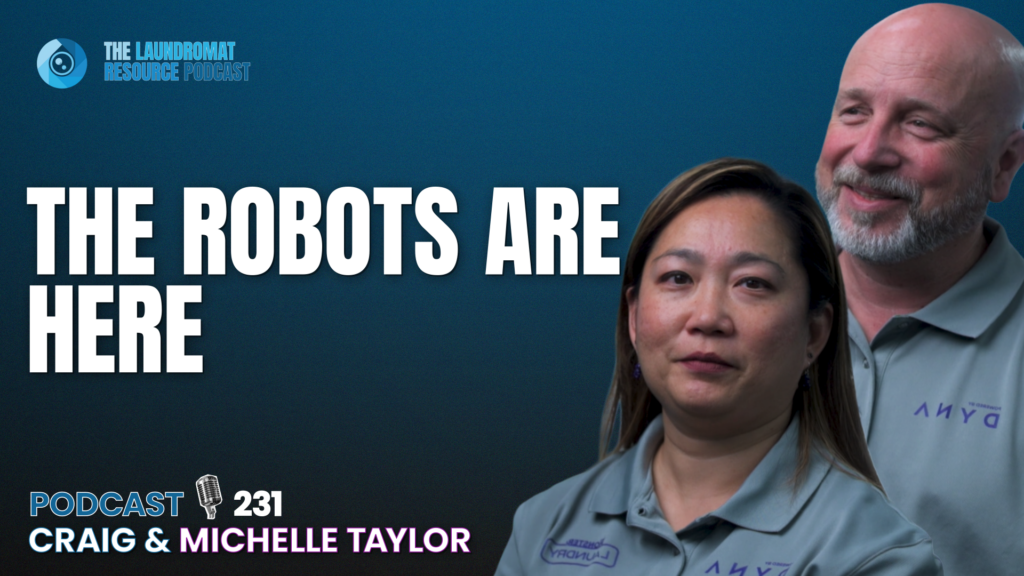
Welcome to another exciting episode of the Laundromat Resource Podcast! In today’s show, Jordan Berry is joined by Craig Taylor and Michelle Taylor, the powerhouse duo behind Monster Laundry in Sacramento. This isn’t just any laundromat conversation—we’re diving deep into how Craig Taylor and Michelle Taylor took a leap into the laundry business, completely rebranding their store with a bold identity and vibrant colors, and transformed it into a clean, welcoming space for families and the community.
But that’s not all—this episode explores the cutting-edge side of the industry, as Craig Taylor and Michelle Taylor share their experiences as some of the very first laundromat owners integrating folding robots into their day-to-day operations. You’ll hear about their journey with Sophy Swiftfold, their new AI-powered folding robot, and what it’s been like to pilot such forward-thinking technology.
Whether you’re a laundromat owner curious about branding, operations, staffing, or just want to peek into the future of automation in laundry, this episode is bursting with practical insights and innovative stories. Plus, get inspired by their approach to team-building, community engagement, and what it takes to stand out in an ever-evolving industry.
Get ready for an episode that proves running a laundromat is about more than washing clothes—it’s about vision, adaptability, and a willingness to embrace the future!
-
Branding Really Matters
Craig Taylor and Michelle Taylor emphasized how developing a strong, recognizable brand made a significant difference in their laundromat’s growth. From designing memorable logos and picking specific color schemes (even tying them to local culture, like the Sacramento Kings’ purple), to keeping consistent branding on all touchpoints (bags, trucks, receipts, even social media), their efforts made their laundromat stand out. They highlighted the importance of surveying customers during the branding process and codifying everything into a branding guide, ensuring consistency. Strong branding helped them be memorable in the community and supported their growth, especially in pickup and delivery. -
Operational Excellence and Automation Drive Growth
The episode detailed how moving from pen-and-paper processes to automated systems (using software like Curbside) improved efficiency and made it possible to scale. Michelle Taylor described how automation enabled them to keep tight control over every order’s “chain of custody,” ensuring quality and preventing errors or lost items. Moreover, their emphasis on staff training, standardized processes (SOPs), and consistency in customer experience were foundational to scaling their wash-and-fold and pickup-and-delivery operations. All these steps led to significant growth—at one point, they 10x’d their pickup and delivery business. -
Embracing Technology and Innovation Is the Future
Perhaps the biggest conversation piece was their early adoption of folding robots (specifically, “Sophie Swiftfold”). Craig Taylor and Michelle Taylor explained that, while the robot didn’t replace employees, it significantly augmented productivity—handling the most time-consuming part of the workflow: folding. Even though the robot starts slow and is still learning, its progress is already material, and it frees up staff to focus on other aspects of the business. They’re also leveraging the robot’s novelty for marketing (with live streams and media attention), illustrating how innovation can become a differentiator in attracting new customers.
Bonus Insight:
The episode provides a great example of how running a laundromat like a true company—with regular team meetings, a focus on culture, careful hiring, and leadership development—pays off. Craig Taylor and Michelle Taylor are actively scaling, positioning themselves in a way most “mom-and-pop” laundromats do not.
In summary: Invest in your brand, modernize and document your processes, and don’t be afraid to try new technology. Owners who do these things will lead the pack as the industry evolves.
Ready to Take the Next Step?
Check out Laundromat Resource for free courses, podcasts, community forums, and expert consulting—all from Jordan Berry , one of the industry’s leading voices. The opportunity in laundromats is real—whether you’re looking for stable cash flow, a business with meaning, or building wealth with real estate.
If you found these tips helpful, share them—and stay tuned for more industry insights from Laundromat Resource.
Resources and Links:
- Laundromat Resource
- [email protected]
- Monster Laundry: https://www.monsterlaundry.com/
- Instagram: monsterlaundryinc
- TikTok: monsterlaundryinc
- Facebook: MonsterLaundryInc
Make sure to watch the latest Laundromat Podcast Episode 231
Craig Taylor [00:00:00]:
Hey.
Jordan Berry [00:00:00]:
Hey, what’s up, guys? It’s Jordan with the Laundromat Resource podcast. This is show 231 and I am mega pumped that you’re here today for multiple reasons. Number one is this is the first episode of the Laundromat Resource podcast coming out in 2026, which is exciting. And we’re talking about robots, which is also exciting. Super duper pumped to have you join me on the show today, learning from Craig and Michelle Taylor, talking about their experience getting a Laundromat and how all that went. But also in addition to that, they have the folding robots in their store. If I’m not mistaken. They’re.
Jordan Berry [00:00:43]:
If not the first, they’re definitely one of the first laundromats utilizing these folding robots. Many of you saw them at the clean show back in August in action. They’ve got them in their store. So super excited for you to hear about how they’re utilizing them, how it’s working. And I will give the caveat that we recorded this few months ago, so we just got to a point where we could get it released. So I’m sure they’re even better now than they were in this episode. So that’s awesome. And real quick, before we jump into it, I just wanted to put a plug out there because I know 2026 New Year, if you’re listening to it around the new year, a lot of times we have goals to get started with our laundromat journey.
Jordan Berry [00:01:29]:
Right? Buy that first laundromat. It could be a super scary step. I was just talking with somebody today who was like, I just need somebody to help me get past the fear. And I wanted to let you know that we have a team of people that can do just that. We have two different programs to help you get into that first laundromat or your next Laundromat. We have a done with you program where you’d be paired up with a one on one coach and given all of our tools and resources that we have to help you get that first one the right way the first time. And we have a done for you program where we actually have a team that goes out and finds you laundromat mats, presents them to you and helps you pick out the right one for you for your situation. So I’ve got it done with you.
Jordan Berry [00:02:15]:
Done for you. Check out laundromatresource.com coaching to get more info on that. You can book a free call over there and get more information about how we might be able to help you in your laundromat journey whether it’s the new year when you listen to this or not. Okay, without further ado, I don’t want to overshadow the Craig and Michelle because they’re awesome, but also we’ve got robots we’re talking about today. So listen, this is a winner of an episode. Can’t wait for you to listen to it. And Again, check out laundromatresource.com coaching if you’re looking to get into that laundromat journey this year. Craig and Michelle, thank you so much for coming on the show.
Jordan Berry [00:02:55]:
I cannot tell you how excited I am to hear your story, but also to hear a little bit about a robot that I’m hearing rumors about. But thank you for coming on. How you guys doing?
Craig Taylor [00:03:06]:
Really good.
Michelle Taylor [00:03:07]:
Yeah, very good. How are you?
Jordan Berry [00:03:08]:
Awesome. I am doing excellent as usual.
Michelle Taylor [00:03:13]:
Not.
Jordan Berry [00:03:13]:
I was gonna say as always, but as usual doing excellent. Hey, listen, I listen, I know we gotta get to this floating robot, but really I want to hear a little bit about you guys. Can we jump in with who are you guys and how did you get into this laundry business?
Craig Taylor [00:03:30]:
I think it was sort of my brainchild to check out the laundry business and actually Michelle and I explored other opportun just as small businesses on Main street and we landed on the laundry space, really explored it. Listened to a lot of your podcasts, Jordan and many others in the industry kind of feeling out is this something that would be viable for our family? And so my background, I have a chemical engineering degree and a master’s of business administration. I’ve been in biotech industry for years as an engineer and a leader of small organizations organizations. Do you want to give your background real quick?
Michelle Taylor [00:04:12]:
Yeah. So I’m actually from Singapore. I came here and then stayed here. We kind of kind of looking at different kind of small business and stuff when Covid hit and we wanted to see what business it’s gonna survive the next pandemic if we have a pandemic. And then we kind of settled on this. I think it was a right, right thing at the right time kind of stuff.
Craig Taylor [00:04:38]:
Yeah. And we looked all around for different laundries to, to purchase and, and really turn around and you know, I’ve gone through every laundry in Sacramento exploring those and we found this one and, and found out it was for sale and we struck a deal and came in and, and turned the store over, put brand new equipment in, floor to ceiling. Everything’s new in the store. We’ve been. And that was back in January 2024. So we’. A year and nine months at this point. Yeah.
Jordan Berry [00:05:12]:
Did you guys. Did you guys rebrand it or was it already branded Monster Laundry?
Craig Taylor [00:05:18]:
That’s a. That’s a good question. Our focus over this last year and a half is to make a name and a brand for exactly my region. It was not named Monster Laundry. It was a very generic name that you’ll find all over laundries in this area. So Monster was a concept of, we can handle Monster, loads of laundry. And. And we, you know, skirt all the rights, the domain, and we work with.
Craig Taylor [00:05:42]:
We have a. Who’s become a really good friend, who’s a local artist that designed the logo mark and overall logo that we have. And that’s. That’s really where we’ve. We’ve gone. Did you want to talk at all about the. The branding also?
Michelle Taylor [00:05:59]:
The branding just. It really started off with just what is kind of funny. And then we settled on. We settled on Monster, and then it kind of resolved. Revolved around that we did have. We were very fortunate. Like Craig said, we had a local artist based in Sacramento that designed all this. We worked together and we designed everything.
Michelle Taylor [00:06:21]:
Designed a logo, the logo mark, the color schemes. It was funny because it wasn’t intentional that I chose purple because Sacramento Kings are purple. But that connects us to the Kings. So our color scheme is teal and purple. And we actually were at a restaurant and I presented the color scheme to Craig and he’s like, there is no way we’re gonna go with this color. No, there’s no way.
Jordan Berry [00:06:50]:
We saw who lost that fight.
Craig Taylor [00:06:52]:
Yeah. Yeah.
Michelle Taylor [00:06:55]:
We talked to our waitress, and I said, hey, can I just ask you what do thing? And she goes, oh, I love it. This is awesome. And we’re very fortunate to belong to a CrossFit community. CrossFit anywhere. And Blair was the owner, was amazing, and let us send out their survey to all the members to PE to pick which logo mark and which color scheme. So that’s where we got all of these.
Craig Taylor [00:07:19]:
Yes, it was. It was a real journey to create the branding, the logo and included sending those surveys out and multiple revisions with the artist to land on that. That look and feel. Now we have a whole branding guide that discusses how to use these. These logo marks and provides all the proper color so we’re consistent. It’s surprising, I mean, even to get the bags for our laundry, to get the right color for those, it’s difficult because they’re just, oh, that’s purple. And they give it to you but it’s not monster purple.
Michelle Taylor [00:07:50]:
Even with the truck. Like, we have customers that says we don’t. They’re not. They’re not even looking at the logos on the truck. They’re just looking at the colors. And once they see the colors, they know that that’s the monster laundry truck.
Craig Taylor [00:08:06]:
Yeah. And I would say, going back to your first question of how we got into this business and. And why we chose it, I was fascinated by the concept of a customer comes in and they put a quarter in and they’re paying for the laundry at the time of service. So there’s really not very much accounts receivable. And so there’s not a lot of exposure there. And there was. There was a lot of discussions around it’s very difficult to fail at a laundry, having a laundry center. And so that drove me to a little bit more safety as we’ve grown.
Craig Taylor [00:08:40]:
And we have commercial accounts, we do have accounts receivable at this point, but that’s kind of a minor piece of the overall financial picture.
Jordan Berry [00:08:50]:
Yeah. Okay. Well, I want to.
Craig Taylor [00:08:52]:
I want to.
Jordan Berry [00:08:54]:
I want to go back and, like, actually hear your. Your story of how it’s been since you got in the industry in a second. But since we started talking about it, I. I wanted to just sit for a second on the branding thing, because I’ve been talking about how branding is going to become more and more important in our industry for laundries to actually have strong brands. And you guys have a strong brand. Right? It’s a strong name, and the color’s strong. Right. Especially for the region that you’re in.
Jordan Berry [00:09:24]:
Like you said, kind of the Sacramento King Sing Purple is. Is all over Sacramento. And, And. And so it’s really strong. But I, I think it’s interesting how you said, hey, we did surveys to help us pick our logo, to help us pick our color. We have a, you know, a brand kit that shows you how to use the logos, how to use the colors, what colors we’re using, kind of all that stuff. I mean, it sounds like you’re taking your branding very seriously. Can you just talk about, like, why taking it so seriously? And have you seen any effect of having taken this brand seriously and.
Jordan Berry [00:10:03]:
And trying to build a strong brand?
Craig Taylor [00:10:06]:
Well, I, I think from the marketing side and advertising side, I’ve been told by multiple marketers that you have to, like, interact with a customer something like 15 times before they’ll decide to purchase your product. I know our numbers on our pickup and delivery have steadily increased since we’ve opened, but they haven’t increased to the extent that I thought they would. I thought it would just kind of explode. It’s more of a slow, gradual increase over time. And I. What we’re seeing is that it’s multiplying. But I believe part of that is around our brand and our. Our interaction with the customers.
Craig Taylor [00:10:49]:
For example, you walk in the store, you see Monster. The Monster logo. You come and you get. You purchase something from the register. The receipt that comes out has the Monster laundry logo on it. All of our materials that when we package, pickup, and delivery order, we. We end up putting postcards inside of. This is a.
Craig Taylor [00:11:12]:
Not the exact postcard we’ve used because it’s advertising the pickup and delivery, but we would. We use postcards that have. Every single postcard has our logo on it. So when it goes to the customer’s house and they’re unpacking their clothes, out comes postcard says Monster right there. So it’s multiple interactions reinforcing the bags that we. We provide free laundry bags to any of our pickup and delivery customers. Those bags and Michelle, it is branded. Okay.
Craig Taylor [00:11:46]:
So a key part of messaging and hey, this is us. Don’t forget about us. Incidentally, Michelle and I have recently started having the team do our laundry. And what I’m finding is at home, we get all this stuff back and Monster logos all over our house now, like on the receipts. And you basically process all that, but you’re constantly getting inundated. Once you become a customer, you absolutely get inundated with the Monster brand. And it’s a question of how do you get those customers that aren’t our customers yet to see us? And so we’re doing things like a frame signs. We have a very busy street that goes by the laundry center.
Craig Taylor [00:12:27]:
Our advertising online all has our logo scheme and our logos. And our logo marks anything that comes out of the company that’s meant to be selling a product has our logo. We do a lot of fun stuff, like on Tick Tock and Facebook and Instagram that they don’t necessarily. It’s not focused on the logo. It’s just more like, hey, this is laundry. We’re here. Have some fun, you know? Yeah. Any.
Craig Taylor [00:12:52]:
Any other thoughts? I’m kind of here. Craig.
Jordan Berry [00:12:56]:
Craig, are you dancing on Tick Tock? Because I’m gonna go follow you right now if you’re dancing on Tick Tock.
Craig Taylor [00:13:02]:
I’m not a big Tick Tock, but I did a little video for Tick Tock as Goofing around, and it got like 2,000 views. I was like, okay, hey, you need.
Jordan Berry [00:13:12]:
To get that robo. I mean, we’ll talk about the robot. You need to get that robot on TikTok, too. People eat that up for sure. Okay, let’s backtrack back to January. Thank you for sharing about the branding. I mean, I think it’s so important, right? And, you know, everybody talks about how, you know, we were sort of like an industrial economy for a while, and then we were an information economy, and now we’re an attention economy. Right.
Jordan Berry [00:13:37]:
And you know, what I loved hearing you say is, like, once you become our customer, you know, you’re inundated with our. Our brand, our logo, our colors, and you just can’t really, like, get away from it, right? And doing some, like, the fun stuff and getting out in front of people, obviously, running ads and having your logo, you know, your customers carrying your logo around the bags on the front porches. If you’re doing pickup delivery, like that kind of stuff, like, I. I mean, that’s all gaining attention for your brand, right? And that stuff tends to. As long as you have a good service, which obviously you guys do, that stuff tends to kind of hockey stick. You get that slow incremental growth, and then all of a sudden you hit that tipping point where people start to know your brand and. And things really start to take off. So sounds like you’re well on your way to doing that.
Jordan Berry [00:14:27]:
And I. I just. I. I love your guys brand. Like, since I saw it, I love your brand. It’s. I think it’s super strong and it’s fun, but. But it also has that sort of like, hey, you know, listen, your laundry doesn’t scare us.
Jordan Berry [00:14:41]:
We’re the monsters here. We’ll take care of that stuff, you.
Craig Taylor [00:14:44]:
Know, I love it. Yeah. Our tagline that was part of the branding was to come up with a tagline. And I can’t take credit. Narcan Michelle is our artist, but our tagline is so clean, it’s scary. Mm.
Jordan Berry [00:14:58]:
I like it. Yeah, I like it. It’s so good. And it’s a fun. It’s a fun brand because there’s a lot of things you can do to play off it, right. That. That’s fun, but also has, like, the meaning that you’re looking for. So I love it.
Jordan Berry [00:15:11]:
I think it’s great. Okay, so let’s rewind back to January 2024. You. You bought this laundromat. This is your first Laundromat, right? Yeah. And. And so you bought this first laundromat. I mean, take us back Tell us, like, how were you feeling at the time when you took over? Were you guys excited? Were you nervous? And then what were, like, some of the first steps that you guys took? When she took over.
Craig Taylor [00:15:38]:
I wanted to hug you.
Michelle Taylor [00:15:41]:
We took over, and it was January 14th. Was talking about the laundry on the 13th. And then he says, yeah, we’re gonna go get the keys tomorrow. I’m like, what do you mean we’re gonna go get the keys tomorrow? He goes, yeah, we’re taking over tomorrow. We’re taking over this laundry center that this laundromat that we kind of already looked at. So that started. We came down. The old owner pretty much gave us the keys and left.
Michelle Taylor [00:16:08]:
Her son came down and walked us through how to open the old machines. It was still, like, the top loaders. It was still the dryers that had multiple keys. So we did that locked up. And he says, yeah, good luck. If you have any questions, call me. That was pretty much it. We kind of figured everything out.
Michelle Taylor [00:16:33]:
I was like, oh, my gosh, there’s no way we can do this. This is a little crazy. And it was all pen and paper. So we run with curbside. Thank goodness that came in. But that’s been such a lifesaver because we did pen and paper. And when we’re going through some of the stuff, we found those receipts that we were using, and, like, there’s no way we would be able to this. Then we started retooling.
Michelle Taylor [00:17:04]:
Craig had this idea that we’re just going to retool the laundry center Monday through Thursday and then open it up to the public Friday through Sunday. That was crazy, because then it was like a huge. Like, the contractors have to take all their stuff out. We have to come in and deep clean. So that was a little crazy. Never happening again.
Jordan Berry [00:17:30]:
That’s crazy. Yeah, but, I mean, I love it, right? Because, I mean, that’s a busy time anyways, and why not get the work done, and then if it’s still usable, people will come, even if you’re in the middle of working on the place.
Craig Taylor [00:17:44]:
Yeah, they did come, but it was. I’m a firm believer now, shut it down, have two months of construction, and then bring it back up if it only takes two months. But that was a big factor. It was constant. It was. We. We did too much. We were thinking, oh, we don’t want to lose the revenue stream, or we didn’t want to lose the customers.
Craig Taylor [00:18:07]:
But, I mean, looking back on it, our customer base has changed significantly since that time period. And really, it’s about attracting new customers, letting people know that we’ve re envisioned this laundry center and it doesn’t look anything like what it did before and getting those customers back in. We could have easily shut down for two months and not worried about customers whatsoever. That was a concern. I remember that was the main driver was we’re going to lose customers. And yeah, that’s not something I would be concerned about right now at all.
Michelle Taylor [00:18:45]:
But we were actually. Craig and I were just talking. There was this movie that. And it was actually shot in Sacramento. That was the time we actually took over the laundry center. And their production team actually reached out to us to see can we do some laundry. And looking at what we have now and what we did before, it’s just night and day now. We can just handle so much more stuff where we’re fairytale.
Michelle Taylor [00:19:12]:
We’re going to get. We’re going to work with. We’re working with like this we’ve had. We work with. So we’re able to kind of handle that. Yeah, it’s pretty cool. So we’re able to do that. We work, we have, we work with some of the performers when they have the tour, they bring the laundry here.
Michelle Taylor [00:19:38]:
Just from then to now, it’s just night and day. So no paper and pan anymore too.
Jordan Berry [00:19:47]:
No more paper and pen.
Craig Taylor [00:19:48]:
Jordan. Jordan, not to kill the vibe. I didn’t talk to you about this before the. The podcast. I do not want any of our customer names going out on podcast to give our competition leverage against us. So if you could strike that whole last response. I’m sorry, Michelle, I. I just.
Craig Taylor [00:20:07]:
We as a company cannot afford that sort of. Oh, well, there’s a customer there and that somebody goes after.
Jordan Berry [00:20:16]:
I’m just making a note for the editor.
Craig Taylor [00:20:19]:
Every customer is extremely valuable. Jordan.
Jordan Berry [00:20:23]:
Yeah, I’m just making a note for the editor real quick.
Michelle Taylor [00:20:26]:
We’ve also kind of started thinking outside the box too because we had a commercial that was shot here that was with collaboration and they did. They shot their commercial here and that’s actually on Instagram. And then we’re gonna have a movie, a horror movie getting shot in a laundry center too. So such night and day from when we first got it in January till now.
Craig Taylor [00:20:52]:
Yeah, I think I’d add to that is that when we took over operations in January, it was. There were so many things that we didn’t know like just running the business and having employees and paying employees. All of those business systems were built in those first six months along with the entire retool. So we took keys in January. June 1, we were done with the retool. And that’s really where both Michelle and I say that’s when we start to grow and really did a concerted effort of growing the operating, establishing the operations, growing our customer base and getting advertising out there and providing consistency. So since June, so it’s about a year and three months of true operations. And I mean, every week we do things a little bit differently and get a little bit better.
Craig Taylor [00:21:42]:
We’re better and better every single week. I mean, to things like handling the laundry that goes through the facility. Michelle has put in place many things in the operational side from my side, finances, having that consistently done and working with teams to pull revenue streams in along with watching the expenses that go out. It has really been a journey. Our staff is at, I’d say 17 currently. We have many part time. Yeah, we, we run a, a dilute pickup and delivery cargo van and we have drivers, we have attendants, and we have one maintenance worker along with a little bit of social media presence with the staff.
Michelle Taylor [00:22:35]:
We’re running out staff, four hour shifts instead of the full eight hours right now. But as we amp up that, we’ll extend the hours.
Craig Taylor [00:22:46]:
So.
Jordan Berry [00:22:48]:
Yeah. Okay, we’ve got a lot to unpack here because you just said a whole lot of stuff that was awesome. I want to. You kind of like casually mentioned this phrase earlier and I want to kind of go back to it and, and understand a little bit what, you know, what you meant and like what caused this. But you mentioned that your, your customer base really has changed from when you bought it to when you reopened and you know, or not reopened because you didn’t close down, but after you retooled and that June 1st when you started to, you know, really grow the business, you said the customer base has changed. Can you talk about, can you talk about what that means? Your customer base has changed. What did it look like before, what did it look like after, and what caused that change?
Michelle Taylor [00:23:39]:
I think just the way that the laundry center is how it looks. It’s very clean. My attendants are constantly cleaning, making sure that there’s no just balance sheets on the floor or, or the floor. There’s no dirt or anything on the floor. If there’s stuff or water or anything, it gets cleaned up right away. We are fully staffed. So we’re fully staffed from 6:00am when we open to when we close at 9:00′.
Craig Taylor [00:24:09]:
Clock.
Michelle Taylor [00:24:09]:
And then.
Craig Taylor [00:24:12]:
Well, I would say that we hire our attendance on three things. Customer service, cleaning and wash, dry, fold and What Michelle’s talking about is the cleaning side of it. This place is impeccably clean. Many people have said this is the cleanest laundry center they’ve ever been in. And they, they. Some people say I could eat off the floors in here, it’s so clean. And that the concept behind that is as a customer approaches with dirty clothes, they need to come to a clean place to get those clothes clean. If it’s dirty to begin with, it’s going to be a turn off.
Craig Taylor [00:24:44]:
So when we talk about the customer base, Jordan, I observed no children whatsoever in this laundry center and it always that sat with me like what’s going on? I remember as a kid going to laundry laundromats and that was just a place I would go as a kid but we had none here and it concerned me. Fast forward a year and three months. We have multiple families coming in daily into this laundry center with children. So that is a distinct change. The pre which was a scary place to go that I would never bring my family or my children to, to a safe place to come with the fully attended staff with people there. They’re going to help you with anything you need and it’s going to be managed. If, if we have somebody who causes a disturbance, we have a process of asking them to leave and escorting them out if that ever happens. And you can imagine in the laundry world that sort of stuff does happen but with respect and care we take care of those issues.
Craig Taylor [00:25:55]:
And our customers have said that they say hey, we know you’re going to take care of a problem if there is one. That’s why I come here. It’s a safe place. So I think when we talk about the change of our customer base from the self service end, it used to be adult, no children to now we’re getting much many more families into the self service space.
Michelle Taylor [00:26:18]:
And our space is also brighter now and with the gentrification that’s going on, we’re getting more people dropping off their laundry. There are some customers that say hey, I would never have done this had you guys at the old laundry because it’s just a little dated, a little old. They say the first thing they say it’s just clean.
Craig Taylor [00:26:40]:
So yeah, yeah, go ahead. Sorry, I was going to dive into. The customer changes in our drop off in our pickup and delivery have also changed drastically. We have 10x our pickup and delivery since March of 2024. And that’s just incredible to see that. I mean it’s a slow progression and it goes up but it’s Not a hockey stick. But it definitely is a slow progression. But in that time we’ve 10x additionally we’ve how many.
Craig Taylor [00:27:15]:
We have many commercial clients. When we first started we had one, maybe two commercial clients. And now we service many different businesses. So the customer base has absolutely changed. We’re getting more referrals and more just opportunities within the community to help people keep their clothes clean.
Jordan Berry [00:27:37]:
Okay. So there’s probably one or two people listening right now that really want to know how in the world you 10x your wash and fold, pickup and delivery. And I’m sure it’s a, you know, it’s not a one off silver bullet. It’s a comprehensive plan that you guys work. But can you give us a little bit of insight into how you actually grew that business well and how you’re growing it.
Craig Taylor [00:27:59]:
A little bit of cherry picking of numbers obviously. But it the growth was through we advertised on Google. We provide consistent service. We do things like converting drop off customer. If a drop off customer comes in, we attempt to get them a pickup and delivery. We I showed you this postcard earlier, but this is, we offer free pickup and delivery. That’s about the only free thing we really do right now. That’s pretty consistent is hey, we’ll come out, we’ll pick it up, we’ll deliver it back.
Craig Taylor [00:28:33]:
There’s no charge for that whatsoever. You just pay for the weight of the clothes you’re sending. So just consistency. I mean our operations, we have an SOP binder that’s like this thick at this point. From a consistency standpoint, we’ve hired and we’ve let go many people because of that consistency need. If somebody’s not working out with regard to the wash, dry, fold process, because that package that goes back to the customer, it needs to look like a present and all the customer has to do is open it and put it into their drawers.
Michelle Taylor [00:29:13]:
I think with operation wise since I run more operations, we went away from paper and pen. We automated all the pickup and delivery. So that allows us again we use curbside so I can’t speak to any other systems. But with curbside it allows me to track where all the, what the packages are. We have a chain of custody that our attendance was started and then they finish it. So there’s no, we don’t break the chain of custody. So with that it allows me to track where everything is, who process it, who folded it, what time we that that allows us to kind of start processing a lot more laundry. What else? Well, right now it’s growing because we have Sophie.
Michelle Taylor [00:30:09]:
So that’s been kind of awesome.
Craig Taylor [00:30:12]:
I think the, the impact of the folding robot. Sophie Swiftfold is our name for her. That is yet to be fully realized in this laundry center. And we have an entire media blitz that’s coming and that’ll affect the entire Sacramento region. Now the. When we think about that growth over the last year and three months, a lot of it is consistency and we’re diving directly into the bread and butter of running a wash dry, fold operation and having that consistency and getting the right staff involved and and those are all challenges that I mean Michelle’s had extremely hard journey there to get it to the level it needs to be. When somebody comes in their package is going to go out the same way irregardless of who holds it. If I hold same way as if one of our attendants folds it.
Craig Taylor [00:31:08]:
So that’s a strong piece of it. We advertise, we do Google clicks. That’s been a piece of it. We’ve been doing a lot of grassroots guerrilla marketing. Michelle and I have gone to a lot of the different places where customers are and put out our flyers like this one to just say hey, this is an opportunity. You can use Monster laundry. Yeah. There’s.
Craig Taylor [00:31:35]:
It’s how to attract customers, how to grow it. But it’s not. When I say 10x it’s slow. It’s not fast at all and it’s a slow progression. We’re currently we get about one new customer a day and some of those stick and a lot don’t. A lot will be one timer. Just the one timer. Like you have a good couple of good example of one timers.
Craig Taylor [00:32:00]:
Right.
Michelle Taylor [00:32:02]:
We have some one timer but I think at least the operation portion of it going away from pen and paper help. Definitely. We saw a job.
Craig Taylor [00:32:13]:
Oh yeah.
Jordan Berry [00:32:15]:
Yeah, yeah. Well okay, real quick because you, you I want to make sure everybody who’s listening on this understand. I mean you mentioned that you, you don’t break the chain of custody. Can you just explain what you mean by that in your, in your op your pickup and delivery wash, dry, fold operation.
Craig Taylor [00:32:31]:
Yeah.
Jordan Berry [00:32:32]:
Just so everybody’s on the same page.
Michelle Taylor [00:32:33]:
Well, let’s say we’re doing. They’re doing a drop off. It gets banned and it gets. Or it gets shelf. The attendant that’s assigned to that specific customers will pull it off the she and they will take that laundry, unload it, put it in the washer. When it’s done, they take it out of the washer, goes into the dryer and when that’s done. They take it and they fold and bag the whole entire order. So we don’t have another attendant come in and say, one attendant A would just do the washing.
Michelle Taylor [00:33:04]:
Attendant B would do the drying, and then attendant C would do the folding. One attendant covers everything. The way that we train here is if you cannot finish. If you cannot finish the packing and the folding, you do not start that load, because then the chain of custody gets broken. And if something gets missing, and we’ve had this happen before where a customer says, I have a blanket. It’s not with me. I go back to one attendant to be like, do you remember this blanket? Have you seen it? And they can say, yes, I’ve seen it, or no, it didn’t come in with this order. And we can go back to the customer.
Michelle Taylor [00:33:43]:
That is also one thing. Why I think our customer likes us too.
Jordan Berry [00:33:48]:
Yeah, yeah. Basically, somebody’s own in the order. Right. All the way through, from beginning to end. And I. I mean, I like that. It does simplify things. And there.
Jordan Berry [00:33:58]:
There are. I should just mention, you know, for the sake of people listening here, there are sort of two philosophies, right? One is you own. You don’t break the chain of custody. You own it all the way through. And the other sort of philosophy that some people employ is you own one part of process. You’re a folder. You are throwing in loads from the washers into the washers and from the washers of the dryers. Right? So there’s different ways to do it.
Jordan Berry [00:34:23]:
But I. I love that. That model where. Where somebody just owns it and. And it simplifies a lot of things for you. Okay, I. I mean, listen, I know we’re sort of like teasing the robot here, but I got a couple questions before we get to the robot. Number one, and I guess this is like, tangentially related.
Jordan Berry [00:34:45]:
I gu. Guess sort of is. You have mentioned multiple times about your staff, how you’ve gone through a whole bunch of staff, how you have 17 staff right now. I mean, can you talk about staffing? How that seems to be like a consistent difficulty that laundromat owners, and probably just business owners in general, struggle to figure out the staffing piece. Have you guys figured it out or, like, what’s the experience been with staffing?
Michelle Taylor [00:35:19]:
So we went to Dave Mentz’s workshop watchdi for workshop. One of the best things that I got from there that he said was, you need to be quick to fire and slow to hire. So we’ve been trying to do that the way that we Work here is. We’re very, very specific on what I want my attendance to do, specific steps to take to make sure that all the end product is the same. So if they can’t kind of get that, then we give them opportunities to grow. And if that doesn’t work, then I just don’t have time to spend more time and more money on them. I mean, to say it really bluntly, we hire. My gosh, it’s like a revolving door.
Craig Taylor [00:36:10]:
I think it is, but it’s also the. We talk about this level of employee who’s just, you know, at minimum wage or a little bit above minimum wage. A lot of times they’ll just. They’ll say, well, I can work here. I can work here. You know, so there’s a lot of turnover. That was unexpected. You think everything’s fine, and the person just.
Craig Taylor [00:36:34]:
They’re gone. And so we attempt to hire and retain staff that want to be part of this organization and build it forward. We conduct quarterly staff meetings where we get everybody together, throw a pizza down. We talk about the vision, where we’re going, we talk about the numbers, how many pounds of laundry we processed each month. And then Michelle spends a lot of time operations during those meetings. But we build that community. We’re attempting to create a community that people are like, I want to be part of that. We’ve actually had staff members who left and said, I want to come back.
Craig Taylor [00:37:06]:
And we’re like, if, you know, good staff and a rep, absolutely come back. So that we’ve had a bit of retention with them and the turnover has gotten less. And when Michelle said, from Dave Mens Laundromat Millionaire basically advised, quick to fire, slow to hire. We slow down the hiring process. We actually have three people interviewing each person that comes through. No person gets an interview without a resume at this organization. We’re using tools like indeed to put out requisitions. Michelle, how many thousands of people.
Craig Taylor [00:37:42]:
Thousands. So Michelle scours through thousands of resumes, and she pulls out cherry picks them, hands them to me. I’ll eyeball them. If they get fine. I. I kind of look at them and say, if this is good, I say, go ahead. And we schedule interviews and then interview processes of three. Three of our staff.
Craig Taylor [00:38:00]:
We have myself and Michelle all interview. And during that process, you kind of suss out, is this person going to work out with a team? Are they the right cultural fit? They have the ability to learn our processes and will they do, they want to grow at the company. And then we make offers, typically within the first week we’ll know if somebody’s going to work out or not. And again, quick to fire. If it’s not working out, then just move on. It’s, that’s a piece of it and it’s a, it’s a tough part. But you know, we, these 17 people, we’re impacting their lives, we’re creating a working environment and our company is growing and we’re going to be, we’re going to have a lot more full time people probably in the next year, at least two to three full time people on board. It just, I’m, I’m kind of.
Craig Taylor [00:38:58]:
Yeah, Michelle. No, not hopefully is happening. We’re already going to a second site in probably a third fairly quickly. So the growth of this company is going to just keep, keep going. But part of it is the people and it’s, it’s actually, it’s a lot of work goes into people, whether it’s the onboarding, offboarding, performance reviews. Those absolutely have to happen. Let people know. And Michelle, you do all this.
Michelle Taylor [00:39:25]:
I think one of the biggest thing that I’ve gotten back from my leads is the quarterly meetings. The quarterly staff meeting. We make them mandatory food and stuff. So if they are able to see everybody and then kind of. Yeah, yeah.
Craig Taylor [00:39:41]:
Sometimes it’s the first time because you have drivers, you have attendants and they’re all in different shifts. Sometimes the first time they go, oh, you’re that person. They meet for the first time. But it’s a, the quarterly staff meeting is a way to set the North Star. Where are we going? And yeah, absolutely. We, we just recently started having. It was our first manager meeting, happened about six months ago. We went to dinner, talked about the direction of company.
Craig Taylor [00:40:09]:
We’re going and this is just Michelle and I and our leads. We have a lead in, I’d say the kind of administrative space, a lead in the, of the attendance and the lead.
Michelle Taylor [00:40:22]:
I think they run the program too. If we’re, if we’re not here, we have a buy in of our leads, then I think, I think that’s one of the things we have buy ins from our leads. That’s a lot. That’s allowing us to grow.
Jordan Berry [00:40:34]:
Yeah, it’s huge. Right. And like what I, what I love, what I’m hearing is that you guys are turning this small business into a company. Like that’s how I like to look at it. Right. You’re building the culture of the company and you’re trying to get the right people in the right fit. And that takes time to find the Right people. And sometimes you find the right people and then they unexplainably leave and you gotta try to find the right person again.
Jordan Berry [00:41:01]:
Right. Like it’s all part of the process, but investing in your people and this is a, this is a lot of like, you know, I talk a lot about moving up the hierarchy as an owner, right. Like when I started in my very first laundromat, I didn’t have that much money. I bought a laundromat all cash and it was a big chunk of the cash that I had. And so early on I was like cleaning the floors and wiping down machines and closing up the shop. Right. And I, my goal was to move up the hierarchy here. And if you don’t do that and offload.
Jordan Berry [00:41:33]:
You know, there’s just so many owners that are doing a lot of things in their business that are they, they probably shouldn’t be doing. Right. Because it doesn’t give you time to think about building the culture which is huge in, in building a business and, and investing into your, your leadership. Right. You’ve got this leadership tier in your business that you’re investing in. And I mean you’re talking about these quarterly staff meetings and these manager meetings. Like not a lot of laundromat owners are doing that yet. There, there are some like you that are savvy and that are doing this, but not very many.
Jordan Berry [00:42:10]:
And I, I think it demonstrates why you guys are having a lot of success, why you’re, why you’re seeing that growth that you’re seeing in your business right now. Because you’re, you’re run it like it’s a company and like you’re going somewhere because you’re going somewhere, right?
Craig Taylor [00:42:26]:
Yeah. Yeah.
Jordan Berry [00:42:31]:
Do you have, are you, are you finding most your people on Indeed. Is that where you’re finding them or like a site like that?
Craig Taylor [00:42:39]:
Michelle, the majority come from.
Michelle Taylor [00:42:43]:
That’s just a lot. You just gotta force for it. But I’ve also. Shelley.
Craig Taylor [00:42:51]:
It’s strange that family friends, some of those will join, have joined organization. We have people that walk in constant walk ins and we say you need a resume and they come back with a resume. And majority is that.
Michelle Taylor [00:43:04]:
I think we have. One of our friends is helping us out and then one of my military friend who is, who’s just retired from the military and is going to come help us do some driving.
Craig Taylor [00:43:18]:
Yeah, it’s, it’s tough because the. Indeed it’s, you’re just the random population. So if you, if you have a well cited person, somebody that, that is A recommendation. Typically those go to the top of the list. You’re like, oh, potentially this person, you know, will work out. It takes a certain individual that is a certain spot in their life that this is good, good for them. And it really. There’s no real age constraint there.
Craig Taylor [00:43:48]:
It’s really just the person that wants to raise their hand and say they want to be part of the organization.
Michelle Taylor [00:43:53]:
And then show up to work.
Craig Taylor [00:43:54]:
Yes. And they show up for work.
Jordan Berry [00:43:56]:
Yeah. Actually be there. Yeah, yeah, that one’s key. And easier said than done sometimes.
Craig Taylor [00:44:01]:
Well, it’s. I mean, it’s pretty obvious, you know, within the first two weeks, if they miss one day, it’s like really nice.
Jordan Berry [00:44:07]:
Yeah. Yeah. Well, yeah. And I mean, I think that that recommendation from a good employee, I mean, you know, good people hang out with good people. Right. So if you’ve got a good employee, chances are pretty good they’ve got family or friends that are. Would also be good employees. So if they’re.
Jordan Berry [00:44:24]:
They’re bringing somebody and saying, hey, my friend is interested, like you said, top of the list. Because good people tend to hang out with good people and would tend to be a good cultural fit as well if the. That employee is a good cultural fit. And I mean, I think you said you. You’ve got somebody doing social media for you. Is that somebody who’s like, on staff?
Craig Taylor [00:44:46]:
Yeah, they’re super part time. They’re helping out with. You know, we have a blog associated with the monster laundry.com website and they’re putting out a blog once a week. And then that’s one individual, and he’s also working on, like, a lot of the artwork, a lot of the. The printed materials we sent out, like the postcards. And then another individual that focuses on TikTok, Facebook and Instagram and just publishing now on the social media side of things. Although we’ve been out there over since about the last month, we’ve been making more of a concerted effort to get more content and better content out about Monster Laundry. So that’s.
Craig Taylor [00:45:27]:
I mean, we’re kind of very young in that piece of the puzzle, but I think it’s an important piece because, you know, certain demographics will be using TikTok. Others demographics, Facebook and Instagram. And so if we can get the message out about us and just have a general presence out there, I think that’s a value. And every once in a while, Michelle and I will pop in an ad and say, hey, you know, come use us 15 off.
Jordan Berry [00:45:57]:
Yeah, yeah, well, yeah, because I was gonna ask you like what, what made you guys decide to invest in, in posting on social? Because again, I think a lot of laundromat owners are not investing in social and don’t. I, I don’t know if they don’t see the value or they don’t know how to do it or, or what. The reasoning behind it is probably a mixture of all those. But you, you believe that there’s value. I know you’re early in on it, so it’s too soon to tell probably. But you believe there’s value in investing in the social presence there.
Craig Taylor [00:46:32]:
Obviously, you know, from. Both of us are concerned with, with acquiring more customers and new customers and this is one of the avenues we do that. There are many other ways that we market, but one avenue is around social media and we believe that that is an effective way to reach some audience. And again, you have to interact with them like 11 times. So it’s a lot just putting stuff out there that’s fun and not necessarily come do your laundry but, but you know, hey, the robot did something funny today. Look at this. You know, or you know, this funny thing happened with some socks between two people. Just random things we can put out there.
Craig Taylor [00:47:16]:
That’s, you know, it is early on, I believe it will return for our company to get better presence out there in the digital space. Just like the Google clicks are out there and we use the, there’s, this is another aspect.
Michelle Taylor [00:47:38]:
They did a whole class at Clean show just for social media. So it’s, it’s there. We just, we just gotta do it. It’s just like AI is coming.
Craig Taylor [00:47:49]:
Oh, AI is not coming. AI is here.
Jordan Berry [00:47:52]:
It’s here.
Michelle Taylor [00:47:54]:
Yeah.
Jordan Berry [00:47:56]:
Yeah, yeah, yeah. And I mean, you know, for whatever it’s worth, which is $0, I think you’re right on that bet. I think that, that is, I think it’s going to be a solid investment for you for a lot of different reasons. If nothing else, then you’ll have something to point to when, you know, when you want to go up to some, you know, big name client, some big business, some, you know, sports team or whatever and say, hey, let us do your laundry for you, here’s who we are. And you’ve got a lot of content even to point to, but it’ll have a lot of benefit even beyond that as well, I think so. Smart. But listen, we’ve put it off long enough. We’ve got to talk about this, this other employee that you’ve got working for you now.
Jordan Berry [00:48:45]:
Which by the way, if you’re listening to this we’ll put a link to their YouTube so you can go check out this. This folding robot. But tell us a little bit about that and when did you get it, why did you get it, and what’s going on with it right now.
Craig Taylor [00:49:01]:
Yeah, Michelle’s better at telling the intro story. I got an email and I’m like, delete.
Michelle Taylor [00:49:07]:
Yeah, so you got the same email. Craig’s usually the one that gets these crazy stuff. So, like, all the crazy ideas comes from Craig. I mean, we love it. We have an AI entry service, which we love that it’s him. He’s just so technical. So all our machines, all our washers are literally hardwired. Every single one is hardwired.
Michelle Taylor [00:49:34]:
And people that comes and says they’ve never seen it like that. But what happens is we got this email from Dyna Robotic Craig, is that I am not interested. We are just swamped. There’s no way. And here I am, which is the more kind of the conservative one. I think I said, no, let’s just take a look at it. Let’s just call Izzy and let’s see what we have. So what we have is now Sophie swiftfold, that is now in our laundry.
Michelle Taylor [00:50:05]:
She is processing seven of our commercial clients. She’s on full display. So anybody that comes to our laundry center during normal business working hours, come to here.
Craig Taylor [00:50:20]:
And I think Michelle said, we should talk to these people. Like, let’s not waste our time. I don’t have time. We gotta get customers and freeze our pickup and delivery. And like, okay, we were scheduled, I think, for a half an hour. Then the ideas started generating. We’re like, we could do this, we could do that. This would be super cool if it was able to fold this.
Craig Taylor [00:50:46]:
And by the end of the call, I think it ran over. Maybe we were at an hour mark. Izzy’s like, yeah, let’s make this happen. What was the next steps? That really, they were just kind of fishing and saying, would this be a laundry they’d want to work with? That’s near their headquarters. They’re. They’re looking at the Bay Area in California. And we followed up that conversation with a return on investment. Conversation of what? What makes a robot in a laundry make any sense whatsoever? So I, you know, being the engineer, technical guy, I pulled out all of the numbers for how much laundry we process for our commercial clients because it’s kind of easier.
Craig Taylor [00:51:25]:
They’re kind of more consistent. They’re like towels, like that. So we worked up kind of how many pounds of laundry would be going through Potentially the robot and what we would need to pay a human to do that same. And it pretty quickly showed a break even. If it processes all of our laundry for all of the commercial clients, then it would absolutely break even for the fees that they suggested would be charged. So through that process of looking at the current numbers and then the decision was made that Dyna Robotics would partner with Monster Laundry to do a pilot project of their robot within our space. From there it just, it just grew, you know, and now we’ve, it’s full blown. They’re operating here, they have their trainer.
Craig Taylor [00:52:18]:
If you jump on our, we have a live feed going 24 hours a day of the robot. I mean it only works basically from 7 to 4 ish Pacific time. So if you want to see it in action, you just have to jump out on our live feed. We’re on YouTube at Monster Laundry Inc. And I’m sure you put a link in the show notes, but we’ve got a trainer here, he’s training constantly. And then Sophie does the folds, you know, and, and yeah, that’s, that’s been the kind of the, the journey with the robot. Super cool.
Michelle Taylor [00:52:51]:
I think one of the biggest things that I’ve been asked at the Clean show and even here is it’s so slow. It’s like I can fold faster than that. But I think for us it’s not about replacing our attendance, it’s about augmenting our attendant. Our bottleneck is a fold. So it’s 25 minutes for us to wash, 30 minutes for us to dry, and over an hour just to fold even cowls. It still takes time. So now what happens is they take the towels from the dryer, put it in a cart and push it into Sophie’s home, Sophie’s enclosure. And Sophie does the work while they start another load.
Michelle Taylor [00:53:29]:
So with, with Sophie, we’re able to process more laundry. And then with, and once Sophie’s done folding, she push it to the side and all the attendant does is when they’re walk to somewhere, they just pick up the pile and then just put it in the bag. So I think it’s, it’s amazing.
Craig Taylor [00:53:50]:
Yeah. And it’s, it’s an augmentation of our workforce. I always think of it kind of like this. We purchase these washing machines. Lots and lots of money go into those. We purchase dryers. Lots and lots of money goes in there. This is just another machine that just does folding.
Craig Taylor [00:54:06]:
And it happens to be AI and it happens to be very complicated and technical, but it’s just Doing another part of the process.
Jordan Berry [00:54:15]:
Yeah. Okay. So first of all, so cool. I mean, that was the.
Michelle Taylor [00:54:21]:
The.
Jordan Berry [00:54:22]:
That was sort of the talk of the clean show. Right. Of the robots. And I did a couple, like, interviews at different booths and stuff. And, you know, people were asking, like, hey, what’s standing out from this clean show? And, you know, I mean, we still got washers, we still got dryers, we still got, you know, the. The normal stuff. But one of the things that stood up pretty much to everybody was the folding robots. Right.
Jordan Berry [00:54:45]:
And you’re right. Like right now they’re slow and they at least start out a little clumsy, and they’re. But they’re learning all the time and getting faster and getting better. We’re at that first iteration. You’re on the, you know, on the leading edge of technology, really, just in general, but definitely in our space with what you’re doing. So it’s interesting to see this thing working in. In an actual laundromat. Right.
Jordan Berry [00:55:13]:
Because I think the question is, is this going to be a feasible, you know, solution to help augment our. Our staff in laundry? And you guys are running that experiment right now to see, you know, if it’s going to be feasible. And I, I think, you know, there’s a. A decent shot that we’re coming to a point where they’re. You’re going to have multiple of these guys, and I don’t. Maybe they’re trained on specific items that they fold specifically, or maybe they learn all the different items and tell the difference. I don’t know. But it’s, you know, it’s really, really interesting to see what this is.
Jordan Berry [00:55:49]:
Is gonna turn out to be like. And it’s really cool to go on your guys link and watch it happen in live in real time, which is. It’s pretty cool. And if you haven’t seen it, definitely go check the link for sure. So who named this thing? That’s what I want to know. Was it you guys?
Michelle Taylor [00:56:10]:
Yeah.
Jordan Berry [00:56:10]:
I like it. I like it.
Michelle Taylor [00:56:13]:
I think it was.
Jordan Berry [00:56:14]:
Yeah.
Michelle Taylor [00:56:14]:
The first time. And then I think Will vetoed it too. Our designer vetoed it too, and then actually came back with it, and I told him it’s not. We need to spell it with a Y instead of an ie because we’re. We want to. We want her to be more bougie.
Craig Taylor [00:56:32]:
Yeah. And like, with Monster Laundry, we’re concerned about branding, so we have to be wearing the Dyna robotic shirt. Michelle, can you turn around? So this is the. The caricature. Oh, yeah. Here come this Way. Okay. This is the caricature of Sophie.
Jordan Berry [00:56:51]:
Yes.
Craig Taylor [00:56:51]:
And our kind of slogan here is AI meets laundry. The future is folded. And so this was, again, our artist put this together, and we have little monster characters we used in our.
Michelle Taylor [00:57:03]:
Our.
Craig Taylor [00:57:04]:
Our media. Again, back to here. This is a step action. You know, sign up online, little zip will come out and collect your stuff, and Tank’s going to bring it back nice and folded. So those are other examples of our. Our branding and marketing. But, yeah, Sophie got her own, like, little book, so. Yeah.
Craig Taylor [00:57:27]:
And I think that the name kind of, you know, out of that effort.
Jordan Berry [00:57:31]:
Yeah, Yeah, I love it. I love it. And I mean, like you said, you give something a name and it gives it, you know, a little more intrigue, a little more interest, and, you know, you got to go watch Sophie Swiftfold folding laundry live on YouTube.
Michelle Taylor [00:57:47]:
A little column on the board. On our whiteboard, too, because our. Each attendant has a little column to tell them what laundry to process. Sophie has her own little column them.
Jordan Berry [00:58:00]:
I love it. Just one of the team. One of the team. Does Sophie go to the quarterly meetings or you keep her working? Okay. She gets the weekends off. Come on.
Craig Taylor [00:58:12]:
That’s. All right.
Jordan Berry [00:58:13]:
All right. That’s funny. Well, I mean, how’s it been going so far? I mean, have you guys been pleased with how the experiment’s been going so far? I mean, obviously, there’s probably room for improvement, because there is for everything, always. But what’s the overall sentiment?
Michelle Taylor [00:58:29]:
I. I think it’s great. I mean, I most. I’m very. I’m a. I’m a stickler on folding. So it has to. The seams has to match.
Michelle Taylor [00:58:39]:
It has to fold. We call it the monster way, like our way. And they’re able to teach her to kind of fold. The seams are great. They’re matching. About 90. 90% of the seams are perfect right now. So that’s.
Michelle Taylor [00:58:57]:
I think it’s amazing.
Craig Taylor [00:58:59]:
Yeah, I think that looking at the progression, we’ve been working with Sophie swiftfold in the laundry for about two months now. And at the beginning, comparing that to now, there’s absolutely an improvement in the speed of folding, the quality of folding, the different items that are folding. So right now we’re focusing just on just simple towel and different types of folds of those towels. So some towels are very simple. It’s just one full. Other are more complex. One fold and then two other folds to make a certain pattern of folding. And all of that was specified to the team, and they’ve been working on generating models.
Craig Taylor [00:59:42]:
And if you ever jump on. If you jump on the live feed, you’ll see the Dyna versus and actually training the model. So he’s making folds, and they’re. They’re. They’re recording all the moves he’s making. That all gets fed into a model that then gets put into an inferencing engine that then drives the actual robot. But we’ve absolutely. I mean, we have seven commercial clients that are being folded with Sophie right now.
Craig Taylor [01:00:09]:
And there’s multiple different types of folders in there in different types of. Of towels. So it is growing. It can also fold T shirts at this point. But I would expect that as we. The system evolves, we’ll be able to roll up just a whole menagerie of different items. And so we will just go through and fold everything and put it aside for processing it to the output.
Jordan Berry [01:00:38]:
That’s crazy. How long have you had her in the store now?
Craig Taylor [01:00:41]:
Now? Two months. Two months? About two months, yeah.
Jordan Berry [01:00:44]:
Two months. And I mean, have you seen. Well, first of all, I got. I got to know how this Dinah trainer, I mean, is he any good at folding? You know, if that’s who’s training? You got to make sure he knows what he’s doing.
Michelle Taylor [01:00:58]:
We’re training him up.
Craig Taylor [01:00:59]:
Yeah.
Michelle Taylor [01:01:00]:
My attendant doesn’t get there in time, and he takes the stuff and just checks it for us and like, okay, hey, yeah, yeah, he can work here after he’s done.
Jordan Berry [01:01:13]:
That’s right. Maybe. Maybe we’ll see if he’s a cultural fit.
Craig Taylor [01:01:16]:
Yeah, yeah.
Jordan Berry [01:01:20]:
H. Have you seen, like, pretty good improvement over the last two months? I mean, I know she’s learning kind of just as she goes, like, how. How quickly is she learning? Just out of curiosity.
Craig Taylor [01:01:35]:
To answer the question, I think the best way to answer it is how quickly is Sophie swiftfold resolving problems that occur? And that really dictates speed because let’s say she picks up a towel, she thinks she’s got one, but she actually has two. And then she has to figure out, oh, there are two there, and then say, oh, there’s two and discard one. That is a problem that as a human, you’re like, oh, easy. Boom. For Sophie and the modeling engine, it is. It has determined. Has to. Once it confirms that it can discard.
Craig Taylor [01:02:12]:
But that takes a while. Other things that happen are like the. Yeah, the seams isn’t wrong. Or the full. If the fold is not correct, like it accidentally gets folded over. It needs to go in and take that apart and get it. So it has Just a nice square or a rectangle, depending on the size.
Michelle Taylor [01:02:32]:
Like how they stack it. So she can move this and it doesn’t topple over.
Craig Taylor [01:02:36]:
So let’s say if everything went perfectly well, folds have reduced in time to fold those. We’ve actually, we’ve seen those numbers for sure. Those have been tightening up. But it’s the challenging situations that sometimes slow down the entire process. So you’re looking at true throughput of the system.
Jordan Berry [01:02:57]:
Yeah, yeah, yeah, well. And I mean obviously she’s only going to get better, faster, more precise, learn new, you know, skills. It’s interesting because I was, I was talking with, I forget who, maybe Waleed or somebody. And then also Elon Musk tweeted about how modeling fingers is very difficult in the ability of fingers and how dexterous fingers are to be able to do things like folding and stuff like that is very difficult. So I know that there’s a lot of like learning that the AI and the robot robots have to figure out, have to learn in order to be able to be as dexterous as a human when it comes to fingers specifically for, for folding. But it’s interesting, you know, and I, I guess I hadn’t really even thought about it in the sense of like problem solving. I like that sort of framework of also that that robot bot has to figure out how to solve problems. And you, you mentioned some simple ones and I think once you start throwing in mixed items.
Jordan Berry [01:04:07]:
Right, just whatever. There’s a whole lot of other problems that get more complex that are going to take some learning to do. But in the meantime, you’ve got, you know, this robot augmenting the most time, time cost chore in a laundromat, in a pickup and delivery or drop off side of the business business and getting better all the time. It’s pretty cool. Have you seen, have you seen or do you anticipate like a big impact in your business in any ways going forward?
Michelle Taylor [01:04:45]:
I hope so. I hope so. I hope we’ll get more customers and you know, the novelty of it, get people to our laundry center. I think besides just laundry, we also offer dry cleaning and alterations. So I’m hoping that once they come in to see Sophie that they get, they can see our other services and maybe we’ll get them as a customer.
Craig Taylor [01:05:11]:
Yeah, yeah, for sure. We’re currently in the stage of the big blast out to the Sacramento region about the Sophie and the technological advancements we’re making in the laundry space. And so we’re being filmed by two of the local news stations over the next week. And we had the local newspaper interview us last last week. And so I believe that may have a big impact on people knowing about Monster in the entire Sacramento region. And that’s kind of more of a marketing sort of push to just let everybody know about the amazing stuff we’re doing here.
Michelle Taylor [01:05:51]:
Yeah.
Jordan Berry [01:05:51]:
Out of curiosity, like how did you line these up? How do you get in the, the pr, you know, with the local news stations and things like did you reach out to them or what did that look like?
Craig Taylor [01:06:01]:
Michelle and I belong to the Rotary Club here in Sacramento and it’s a, it’s one of the most active Rotary clubs in the entire nation or at least the, or California. There are only three that have paid staff in Sacramento’s waterfall. So we, we have contacts within that network that got us into talking to the Sacramento Bee. And then we have family friends of other businesses that help to get our, our name in front of a few of the reporters. And then what’s that? Oh yeah. If you’re in Sacramento region, Forgotten bakery, amazing bagels, empanadas to die for.
Michelle Taylor [01:06:40]:
They handle them.
Craig Taylor [01:06:42]:
Yeah. And they’re an amazing, amazing company. Kind of like us in the sense of pushing that leading edge. But we had a customer come in and actually get us in front of one of the newscasters. That was just an amazing interaction. We had. Her washing machine had broken and then she came into the laundry and we started talking.
Jordan Berry [01:07:08]:
That’s awesome.
Craig Taylor [01:07:09]:
Awesome.
Jordan Berry [01:07:09]:
That’s awesome.
Craig Taylor [01:07:10]:
And.
Jordan Berry [01:07:13]:
What I also like about it is that you’ve got this multi prong approach. Right. You said you’re doing some Google Ads, you’ve got some guerilla marketing and flyers going out, you’re upselling existing customers, you’re doing PR like your social media. You’ve got a whole lot of things going. That’s why I was asking you about oh, how did you 10x your pickup and delivery knowing that it wasn’t just one thing that you’re doing whole bunch of things. A comprehensive cohesive strategy that you guys are implementing along with the customer experience, the strong branding and you know, the, the, the strong culture of employees that you have there. You know, the rigorous hiring standards, the thick book of sops. Like when you start like think about like everybody wants a good business, obviously everybody wants a great laundromat and a in a great laundromat empire and all that.
Jordan Berry [01:08:10]:
But, but very few are doing all of the things that it takes to build that business. But you guys are on top of it and you’ve got Sophie Swiftfold. So you’re, you know, you’re on it right now. You guys are on it to win it. I love it.
Michelle Taylor [01:08:28]:
Any.
Jordan Berry [01:08:30]:
First of all, this has been incredible. First of all, just hearing your. Your journey in this business has been great.
Craig Taylor [01:08:37]:
Great.
Jordan Berry [01:08:38]:
You know, taking over a laundromat and basically having to redo the whole thing and pulling away some lessons on how you did that and how you would do that differently was great. But then the ways that you’re pushing this business to. To greater heist was great. So I appreciate you guys taking the time to come on and share your story and to share how you’re using robotics in your business. Is there anything else you want to leave us with before we wrap this thing up?
Craig Taylor [01:09:06]:
I. I think we’re always open to people reaching out and talking. There are a lot of people that helped Michelle and I get to where we’re currently at. Yeah. The last year, almost two years now, we’ve had so many coaches, so many people that we’ve called and talked to. Jordan, you indirectly absolutely influenced me. And through us, I’ve watched so many of your podcasts. I.
Craig Taylor [01:09:34]:
It just. So Michelle and I are open to that sort of discussion if anybody wants to reach out. Just.
Michelle Taylor [01:09:39]:
Yeah, we’re very, we’ve been very fortunate on whose culture this journey and who’s been there for us. I think one of the things too is don’t be afraid if you’re new laundromat owners or even if you, I guess, have it for a while. Just don’t be afraid to ask questions. I have no shame. So I just ask. And if I don’t understand, I said, well, that doesn’t make any sense. So you know, I, yeah, I think I have no shame. I just keep asking questions.
Michelle Taylor [01:10:11]:
But I, yeah, I think I’m also work together. We’re open to like people asking us questions too. So yeah, whatever we can help.
Craig Taylor [01:10:20]:
And we’re just. You can find us on our website, Monster Laundry.com and just support@monster laundry.com get to either Michelle or I and we’re. We’re on Facebook, Instagram and Tik Tok also is mostly the brand. The moniker is always Monster Laundry or Monster Laundry Inc. And you can find us.
Jordan Berry [01:10:43]:
Awesome. Well, I definitely go to TikTok and watch Craig dance with the. With a robot. You need to choreograph a dance with the robot. Come on, Craig. The people. The people want it. The people want it.
Jordan Berry [01:10:54]:
Craig, Come on. Yeah. Yeah. Okay, well, this is. Listen, you guys are great. I again, I really Appreciate you guys coming on. This was so good, so fun. And you know, I’ve got family up in that area, so next time I’m up there, I’m gonna have to come by and, you know, say hi to you guys and, and check Sophie swiftfold out in person as well.
Jordan Berry [01:11:21]:
I will make sure your links to everything are in the show Notes page. So if you want to reach out to those guys, obviously, you know, they just mentioned the different places you can connect, but we’ll also have links to that in the show notes or if you’re on YouTube that all be down below, including the link to hang out with Sophie swiftfold online and live, live, live stream in there. So I’ll have all that stuff there. Guys, I appreciate you guys so much and let’s stay in touch because we want to hear how, how Sophie’s doing as she evolves and gets better at the business. And we want to hear how your business is evolving and growing over time as well. Hope you love that episode. Listen, progress is coming. We’ve got AI all over the place.
Jordan Berry [01:12:06]:
We’ve got robots now entering the chat and automation galore. And some of us are still debating coins versus cards. All right, so listen, this stuff is coming, it’s here, and it’s only gonna accelerate it’s way into our industry. And you can either embrace it, find ways to utilize it as a tool, or you can be a dinosaur. I don’t know, that’s up to you, but that’s kind of my perspective on it. Listen, as always, if you don’t find something to take action on from this episode, you will have wasted your entire time. So find something, pick something, take action on it this week and we’ll see you next time.
Craig Taylor [01:12:51]:
Peace.
Watch The Podcast Here
Resumen en español
¡Por supuesto! Aquí tienes el resumen del episodio “Podcast Show 231” del Laundromat Resource en español:
En este primer episodio del año 2026, Jordan Berry entrevista a Craig Taylor y Michelle Taylor, propietarios de Monster Laundry en Sacramento. Ellos cuentan cómo fue su entrada al negocio de lavanderías, desde la compra del local en enero de 2024, la renovación completa de las instalaciones, el desarrollo de una marca sólida y sus estrategias para atraer y fidelizar clientes.
Un punto destacado del episodio es la incorporación de tecnología avanzada en su lavandería, especialmente la presencia de “Sophie Swiftfold”, un robot plegador de ropa. Craig Taylor y Michelle Taylor comparten cómo el robot ha ayudado a optimizar los procesos de lavado y doblado, aumentando la eficiencia sin reemplazar al personal, sino complementándolo. Hablan también sobre los desafíos y aprendizajes en la gestión de equipos, sobre todo en la selección y retención de empleados.
Se profundiza en el impacto del branding, la importancia de ofrecer una experiencia al cliente impecable y cómo han logrado multiplicar por diez sus servicios de recogida y entrega a domicilio, utilizando campañas de marketing, redes sociales, y colaboraciones locales. Además, mencionan la inminente aparición en medios regionales gracias a la novedad del robot, lo cual esperan les ayude a seguir creciendo.
El mensaje final del episodio es claro: la tecnología y la automatización están transformando la industria de las lavanderías, y quienes adopten estas innovaciones estarán mejor preparados para el futuro.
¿Quieres un resumen más corto o enfocado en algún aspecto específico? ¡Avísame!


Links from the Show
Become a Laundromat Pro & Join the Pro Community!
Unlock the secrets of laundromat success! Join our Pro Community now to access expert insights, exclusive resources, a vibrant community, and more.